Looking for Jupiter in Manhattan
A glimpse of what New Yorkers are missing above the city’s light-polluted skies
Nhung Nguyen • April 2, 2026
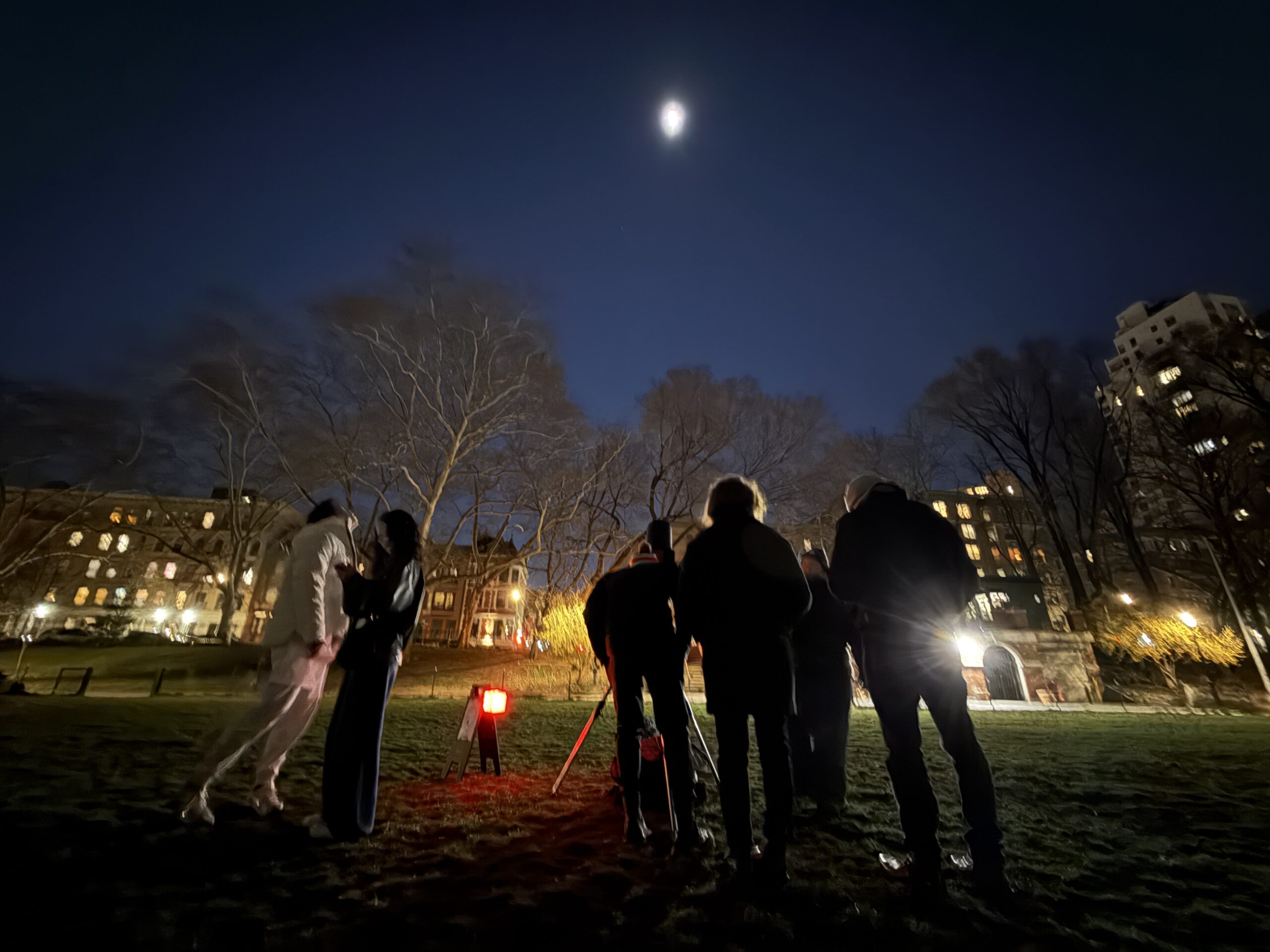
The meet-up, organized by Amateur Astronomers Association (AAA) and West Harlem Art Fund, aimed to pull the stars and people closer to each other. [Credit: Nhung Nguyen]
On one of the coldest nights in March, dozens of people gathered in the middle of the baseball field in Morningside Park in Upper Manhattan. They stood, stooped and squinted into telescopes of different sizes.
All eyes were on one goal: to peer up at the open sky through the dome of obscuring light pollution and, hopefully, marvel at the moon and the stars beyond.
“You might have to close one eye. Let me hold one eye closed for you.” A father held his daughter up high enough for her to reach a telescope’s eyepiece. “Did you see it?”, he asked. She nodded, giggling.
“Oh you can see all the bubbles,” one woman gasped as she spotted the Moon’s surface through the lens. “It looks so textured.” Around her, members of the Amateur Astronomers Association (AAA) had finished setting up seven cosmic peepers on the grass.
“This is the first stargazing event we’ve had in Harlem,” said Savona Bailey-McClain, executive director of West Harlem Art Fund, who hosted it with the AAA. She hoped the moon and the stars would bring people outside and make outdoor activities in public spaces more welcoming — especially to people of color. “The goal is to connect people to nature,” she added.
Unpredictable weather had forced them to reschedule three times since last December. “We had the coldest winter in 20 years, it was snowing and also too cold,” said Kat Troche, AAA president, adjusting her own skyward lens. “So low temperatures are bad for the telescopes?” one curious attendant asked. “No, bad for me, I’d be freezing,” Troche replied, laughing.
AAA hosts around 100 free viewing sessions a year in 17 locations across the city. On the same night Harlem hosted its first public stargazing meetup, another group was also admiring the stars from Inwood Hill Park at the northern tip of Manhattan.
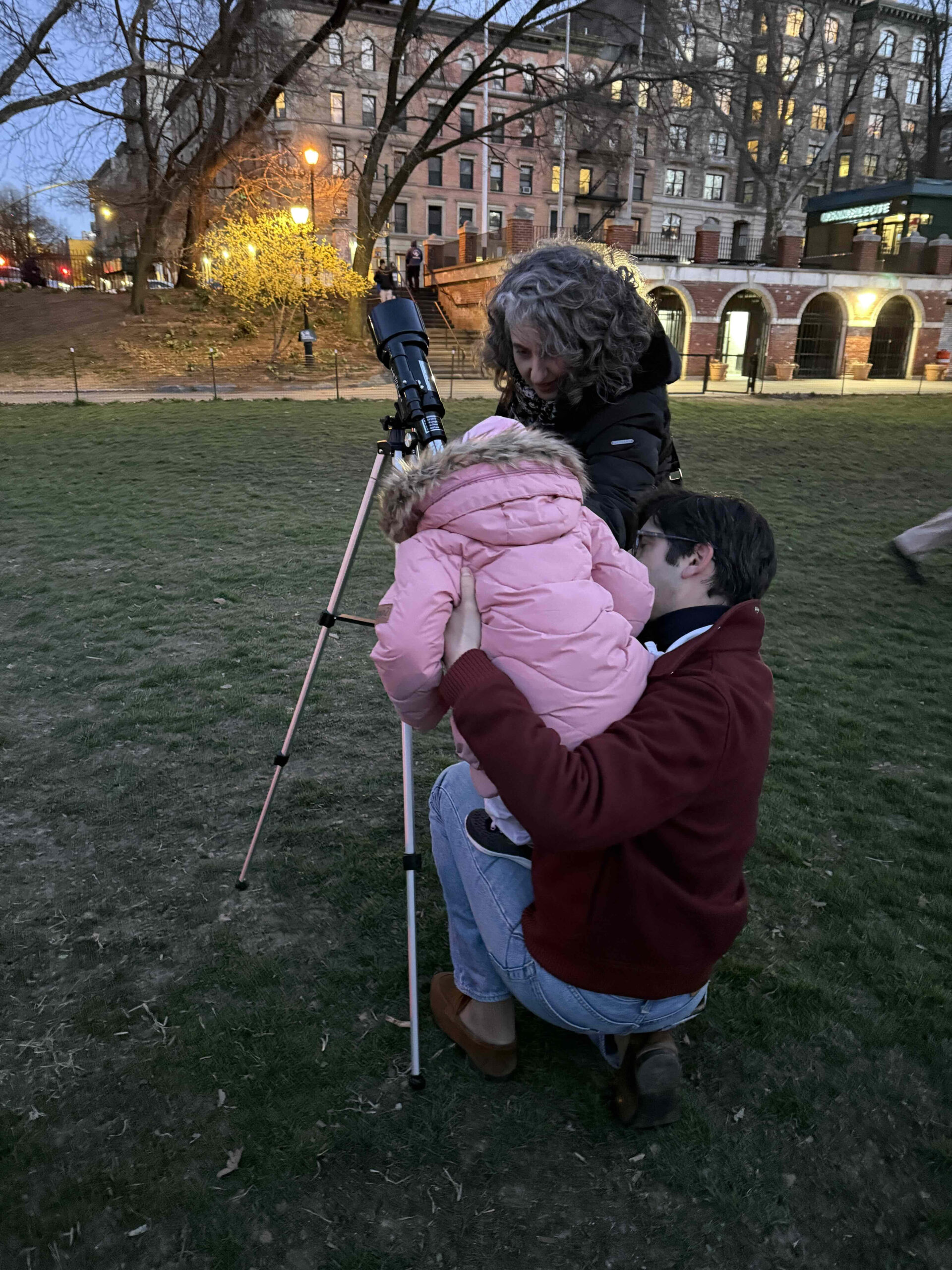
Close one eye and squint! A family joined Harlem’s first stargazing event in Morningside Park, Upper Manhattan. [Credit: Nhung Nguyen]
“I saw Jupiter — it has stripes!” a kid jumped up and down, yelling. As the sky deepened into darkness, the stars started making a brighter appearance, drawing in steady lines around the telescopes.
“I haven’t really stargazed as much, because I spend my entire life living in cities,” said Jake Ha, an undergraduate from New York University, who came for a creative assignment for his History of the Universe class. “It’s amazing. I’m surprised that you can see this many stars from New York,” added Luana Rodriguez, Ha’s classmate.
Elizabeth Parker, who lives nearby, learned about the event by Googling fun things to do in the neighborhood on the weekend. “I’m pushing myself to be out, with people,” she said, “not let the cold stop me, and not let my situation affect me. You know?” Parker has been trying to look for a job, but it’s not been easy in this economy. “Tonight, I just wanted to see the stars,” she said.
Others, waiting for their turns at the telescope, pointed at the twinkling dots piercing the light haze. “Careful, don’t mistake them with the plane,” one told another, laughing.
Nearby, high school student and amateur astronomer Remy Schanzer adjusted his new mini-observatory with quiet pride. “Oh, I just started five months ago,” he chatted with other attendees, “Manhattan is the worst place in the world to get into it, because of all the pollution. But I still enjoy it.”
New York City is debating The Dark Skies Protection Act, a bill aimed to combat the city’s vexing light pollution by limiting artificial lighting between 11 p.m. and 5 a.m. The massive white glowing haze blazing from skyscrapers, high-intensity LED billboards and street lights not only dims the Milky Way, but also disrupts human sleep and bird migrations, all while driving up electricity costs and the city’s carbon footprint. However, opponents are concerned a dimmer New York would render neighborhoods unsafe.
“If the parks department can just shield these two bright lights there so they angle down, that’d be great,” Kat Troche pointed at two LED lights from a public bathroom a few steps away from her telescope’s tripod. She had been threading blue light-filtering lenses onto the bottom of the optical tube, attempting to show everyone a four-star cluster emerging out of the nebula. “They can leave the bathroom light open. The warm light doesn’t really bother us, it’s just the LEDs.”
Astronomers elsewhere have had more luck in advocating for dark skies. Tucson, a major city in Arizona, has positioned itself as a world capital of astronomy by adopting low-blue lights that are shielded and directed downward. Other states have also enacted measures to curb light pollution, including requiring cutoff luminaires above certain brightness levels and prioritizing alternatives, such as lower speed limits and reflective markers instead of adding more roadway lighting.
At last, the four stars emerged on the other end of Troche’s tube, like bright specks of dust on a deep blue background. “Eventually, they’ll go their separate ways,” she told a first-time stargazer who squinted to catch a glimpse. “Our own Sun was formed out of a stellar nursery like that,” Troche said.
Without the telescopes, the group could only make experienced guesses as to the rest of the night sky. “You have the Orion constellation here. Aldebaran and Taurus may be there,” they gestured. The Bull and the Pleiades are kind of hard to see, Troche said, but the Pleiades must be around somewhere above the tree line.
Before it was obscured by artificial light, the Milky Way above them for centuries was considered the path to heaven by Lenape people — the Indigenous people of the Mid-Atlantic coast. In some accounts, Opitëmakàn, or “the White Road” is where the souls of good people travel along it to the beautiful Land to live with the Great Creator, Kishelemukong, with the stars the footprints of the spirit.
For anyone who is still eager to look up, whether for leisure or science, Troche said more stargazing opportunities are coming up in different neighborhoods across New York City. “We are volunteer-based; and one member is moving to this area,” Troche added. “Once he gets settled and wants to come out, you’ll get more events in Harlem by August, September.” If you’re interested, keep an eye on AAA’s observing calendar, and make sure your notifications are up to date, since events sometimes are cancelled if the clouds and the changing temperatures do not allow it.
“I might be joining them again next time,” Parker, the local resident, said as the tour of the stars was winding down. “This is just the perfect end of my night: had dinner, went outside, in good company, and looked at the moon.”
