Oregon’s state-regulated mushroom therapy linked with mental health improvements
A new study provides the first glimpse of real-world outcomes from Oregon, the first state to legalize psilocybin
Helen Wagner • November 18, 2026
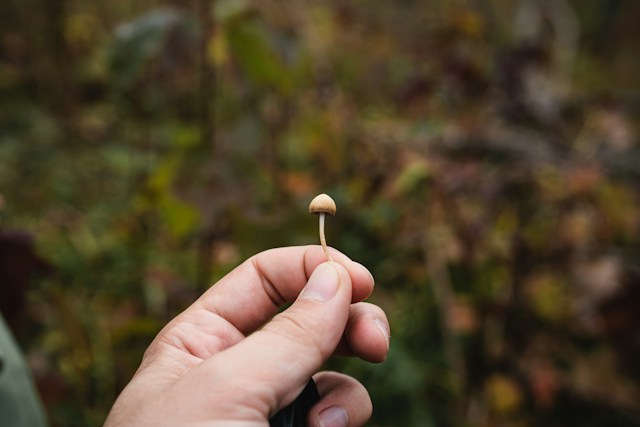
Psilocybin, the active ingredient in magic mushroom, is associated with mental health improvement, according to this study [Credit: Unsplash | Unsplash License]
Could psychedelic drugs help people grappling with depression? Oregon’s psilocybin therapy program might say yes: a recent study showed decreased symptoms of mental illness after supervised use of hallucinogenic mushrooms.
“This is psilocybin in the real world,” says Dr. Todd Korthuis, a researcher from Oregon Science and Health University who worked on the study. He worried that the safety of controlled clinical trials wouldn’t translate to a broader setting, but he finds his results “reassuring.” The therapy is not only safe but associated with improvements in anxiety, depression, PTSD, life satisfaction and well-being for those who use the drug, he says.
Though the study is ongoing, the paper, published in August, includes data from 346 participants who used psilocybin between November 2024 and March 2026. The sessions — supervised by licensed facilitators — took place on-site at Oregon’s therapy centers, where over 20,000 customers have paid from $375 to thousands of dollars per session for the experience since it became available in 2023, Korthuis says.
Participants self-reported their symptoms of depression, anxiety and PTSD at checkups up to three months after a psilocybin session. After three months, depression symptoms had decreased by 60%, anxiety by 71% and PTSD by 65%. Reports of life satisfaction increased by 31%.
“Psilocybin might not be best characterized as an antidepressant, but an anti-distressant,” says Dr. Joshua Rosenblat, who studies psychedelics and mental health at the University of Toronto and was not involved in the study. “It’s not just about improvements of mood, of enjoyment, but reduction in distress levels, in anxiety, [and] improvement in quality of life. It’s showing promising results across so many disorders.”
Only four of the 346 participants reported serious side effects during or after sessions — like stomach pain, behavioral changes or subsequent emergency room visits — but facilitators reported an additional seven who also dealt with impacts such as nausea and vomiting during administration. “There was no consensus about what constitutes a psychedelic adverse event when we started the study,” says Korthuis, but new standards are emerging.
The study didn’t have a control group, a major limitation that Korthuis hopes to change in the future, and which he says the National Institutes of Health (NIH) is now funding. A more rigorous comparison, he says, would provide more confidence that these results are actually due to the drug itself.
Rosenblat wishes that symptom surveys like the one used in this study were mandatory for everyone who enrolls in the state program, because it would make research better. “There’s a major selection bias here,” he says. “People agreeing to participate in a study like this likely already believe in the treatment.”
He cites the relatively small sample size — just 346 of 20,000 users — as an additional limitation. But, he says, this study is an important step: “It’s the largest group, to my knowledge, that’s been a real-world effective study relating to psilocybin.”
“Initially, we didn’t have funding for any of this,” Korthuis says. Since then, the research has received support from the Substance Abuse and Mental Health Services Administration and the National Institute on Drug Abuse at the NIH. In recent years, Colorado and New Mexico have also legalized the drug, which expands research opportunities.
In October, Jason Luoma from the Portland Institute of Psychedelic Science presented the study at the New York Academy of Medicine, during the 19th Horizons: Perspectives on Psychedelics conference.
More data will come from Colorado and Oregon in the future, Korthuis says. “The story is evolving.”
