Two chemists win 2026 Nobel Prize for solution to ‘mirror image’ problem
Understanding the creation and amplification of chiral molecules is foundational to organic chemistry and drug synthesis
Nicole Less • October 7, 2026
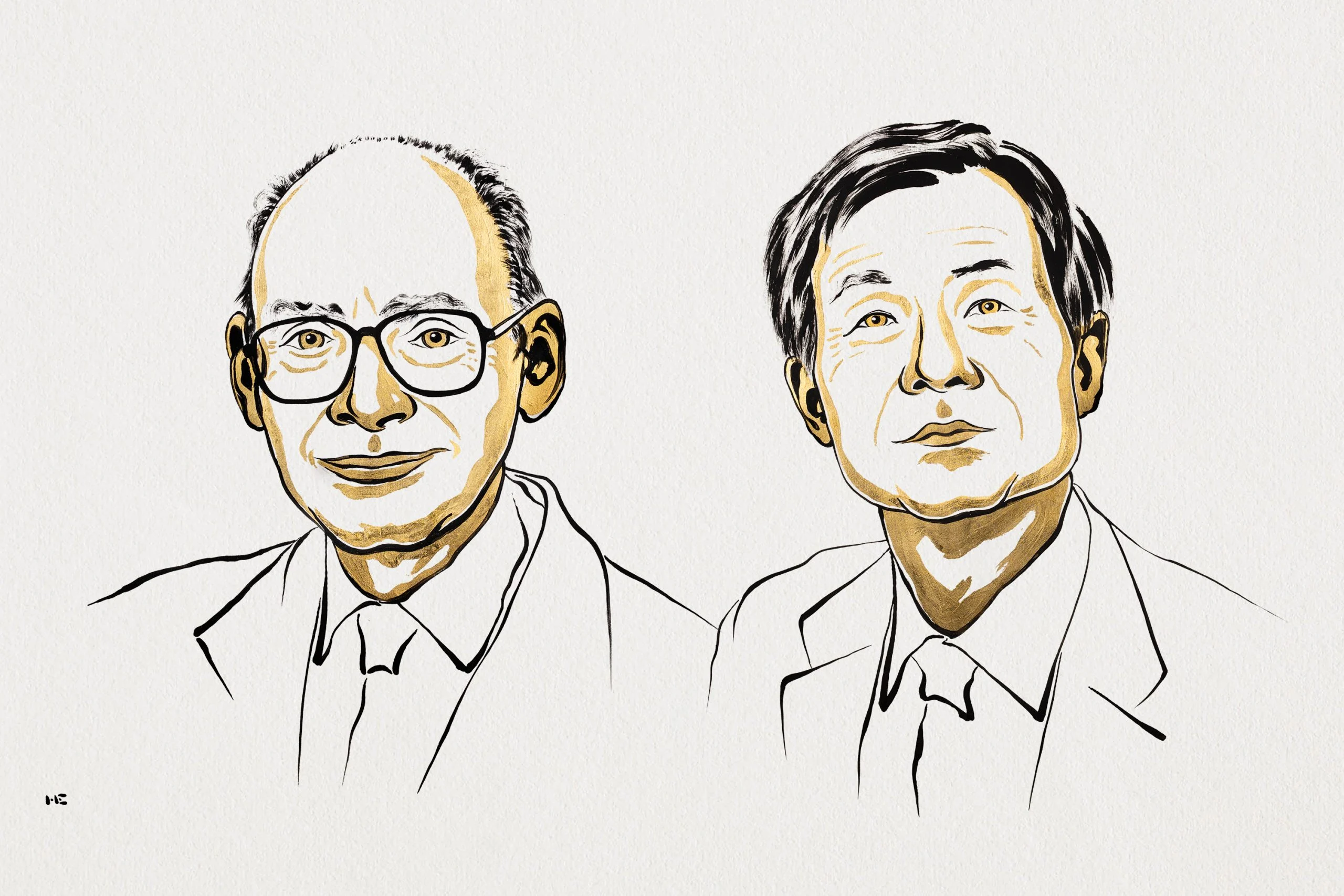
Henri B. Kagan and Kenso Soai won the Nobel Prize for chemistry thanks to their work on chirality. [Image credit: Ill. Niklas Elmehed © Nobel Prize Outreach]
Henri B. Kagan, a 95-year-old French scientist, and Kenso Soai, a 76-year-old Japanese scientist, were awarded the 2026 Nobel Prize in chemistry today for their work on manipulating a mirrored molecule’s chemical reaction.
“Many molecules occur in two different versions. Like my hands, they are one another’s mirror image. They look alike, but they are not identical,” said Heiner Linke, chair of the Nobel Committee for Chemistry.
Molecules like amino acids are chiral, meaning they share a chemical formula but are mirrors of each other.
When chemists began to synthesize molecules, they would get equal proportions of each chiral direction in their results. But the molecules that appear in nature only show up as one version. One version may be useful, while the other could have a completely different effect or even be harmful, said Linke.
The ability to induce a chemical reaction to produce only one chirality was critical for pharmaceutical and consumer product production.
How chirality developed remains one of the great mysteries of the origins of life. Kagan and Soai not only simulated what could have ignited a spark of handedness into a chiral world four billion years ago, but proved we could manipulate in either direction, said Peter Somfai, a member of the Nobel Committee for Chemistry.
Pharmaceuticals and consumer products often use chiral molecules for different effects. For example, the two mirrored versions of the molecule propoxyphene produce two completely different therapeutic outcomes. The left-handed version is a cough medicine (Novrad) and the right-handed version a painkiller (Darvon, or the reverse of Novrad), explained Somfai, a member of the Nobel Committee for Chemistry.
When scientists perform chemical reactions, molecules are combined to induce some sort of effect. In this case, chiral catalysts are added to existing molecules, to steer the reactions toward one of the possible mirrored molecules. Kagan discovered that simulated reactions didn’t have to be a fifty-fifty split between the initial molecule and chiral catalyst. In fact, the molecules produced by the reaction will randomly skew one way or the other. He successfully steered reactions to produce an excess of one or the other potential mirrored molecules, said Somfai.
Kagan’s work showed that a small imbalance of left-handed and right-handed molecules could be magnified. Soai wanted to know just how far he could push a chiral direction. He theorized that the product of a reaction could also be used as a self-reinforcing catalyst. Essentially, adding more of the product to itself would amplify the strength of the chiral direction.
After three reactions, Soai produced a molecule 630,000 times stronger in one mirrored direction than the first reaction. This process is known today as asymmetric autocatalysis or the Soai reaction.
Soai and Kagan’s work allow us to experiment with purer versions of chiral molecules.
The committee called Soai during the news conference who described today one of the most exciting days of his life. He urged the next generation of chemists to continue exploring the properties and transmission of chirality.
Somfai described the work recognized today as foundational to how all chemists pursue all drug development.
“It might be difficult to say that this drug or that drug was developed using this. [It’s] all of them, because we have this as a tool.”
Filed To
Share
About the Author

Nicole Less
Nicole is a New York based journalist passionate about making science accessible with a special interest in public health.