Is dark matter just an illusion?
The dark matter debate drags on with an unconventional cosmological model that claims to explain the strange behavior of galaxies
Madeline Shaw • January 30, 2026
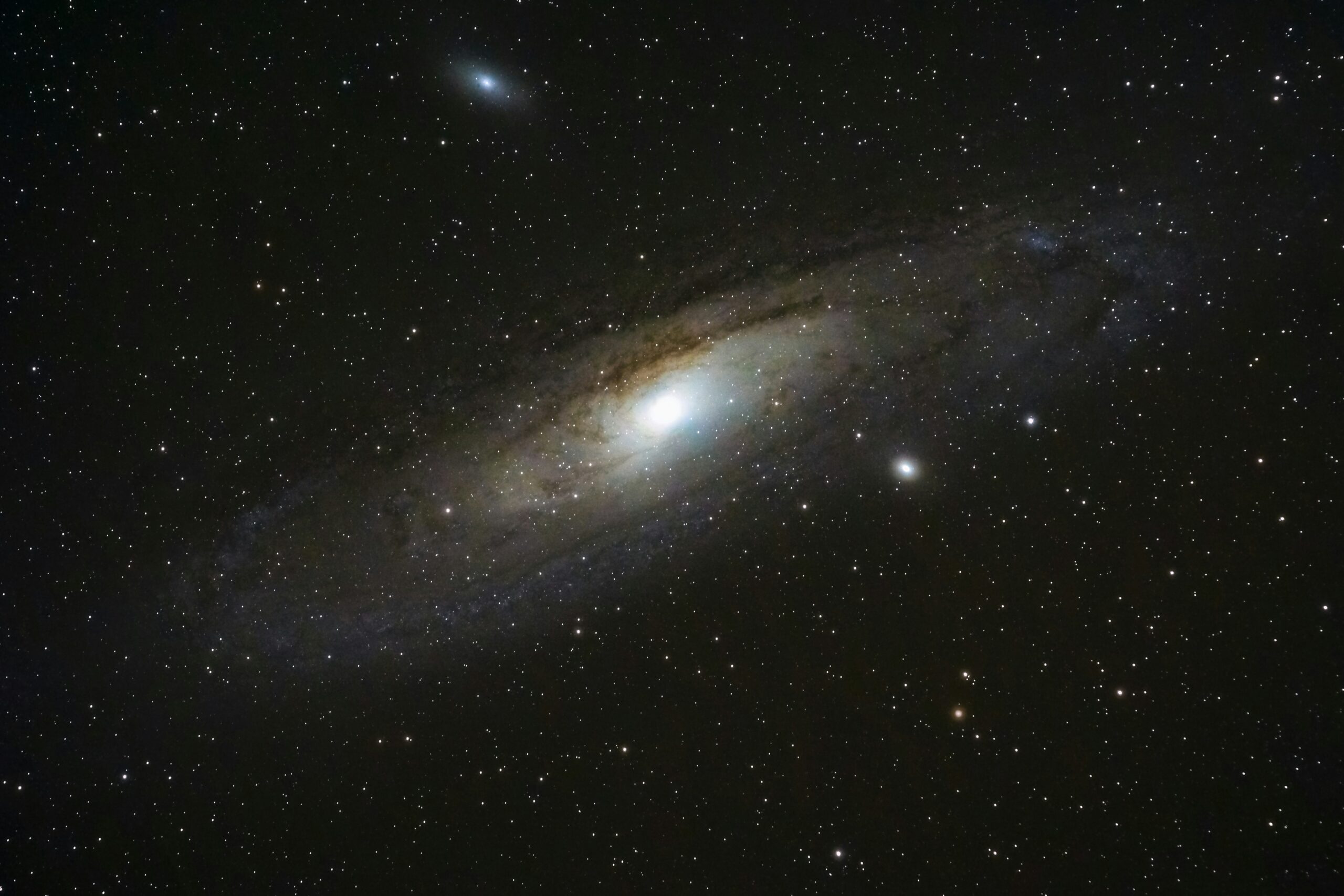
The rotation of stars in the Andromeda Galaxy is considered key evidence for dark matter’s existence, though not all astrophysicists agree. [Credit: Bryan Goff | Unsplash license]
In 1970, astronomers Vera Rubin and Kent Ford published a paper about the Andromeda Galaxy that would revolutionize the study of the universe and challenge foundational principles of physics.
Rubin and Ford showed that stars at the galaxy’s edge were orbiting just as fast as those closer to the center — a phenomenon known as the flat rotation curve, which has since been detected in many other galaxies. These observations flew in the face of Newtonian gravity, which states speed should change according to mass and distance from the galaxy’s center.
According to the laws of physics, the stars furthest from the heart of the galaxy should have been traveling much slower than the stars toward the center. That led astronomers to believe that there must be lots of unseen mass toward the edge of the galaxy accounting for all this extra speed. This was the first major piece of evidence for the mysterious, invisible substance known as dark matter.
First proposed by Swiss astronomer Fritz Zwicky in 1933, dark matter is one of the universe’s great mysteries. Together with dark energy — the force causing the universe to expand faster — it forms the backbone of the standard model for explaining the universe, Lambda-CDM. Astronomers estimate that it could make up 27% of the entire universe. However, despite dark matter’s foundational theoretical role, it’s never been seen, though many have tried.
But maybe there’s a simple reason: it isn’t real.
That’s according to a model put forward by Rajendra Gupta, an astrophysicist at the University of Ottawa. Under his framework, which he calls covarying coupling constants and tired light (CCC+TL), fundamental forces like gravity aren’t actually constant. Under his model, the forces of the universe are weakening as the universe gets older. They’re also lumpy, behaving differently even within individual galaxies.
Crucially, with Gupta’s approach, there would be no need for dark matter to explain things throughout the universe.
In a paper published in the journal Galaxies last September, Gupta put his framework to the test by applying his mathematical models to galaxy rotation curves from seven different galaxies. Whereas the normal calculation method is to look at the amount of visible matter (also known as baryonic matter) in a galaxy and determine the amount of dark matter needed to fit the rotation curve, he did something different.
Instead, Gupta used his formulas to reverse engineer the amount of visible matter that should be in the galaxy using the rotation curve and his formulas to see if it matched with the observations. According to his new paper, his results generally aligned in six out of the seven galaxies.
Through his calculations, Gupta found that gravity should get stronger on the edges of galaxies, where there is less baryonic matter. This would mean effects previously attributed to dark matter are nothing more than an illusion.
“This came out from the equations directly,” Gupta said.
Others are skeptical of Gupta’s claims.
“There is plenty of evidence for dark matter,” said Julian Muñoz, a theoretical cosmologist at the University of Texas at Austin who studies dark matter. To prove Gupta’s model, “you will need more evidence beyond the rotation curves of galaxies.”
Muñoz pointed to the Bullet Cluster as a key example. The Bullet Cluster formed when two galaxy clusters collided, with visible matter slamming together in a cloud of gas and dust. However, using data from the James Webb Space Telescope, astronomers found light-bending signatures attributed to dark matter on the outskirts of the collision. Because these signatures appeared in a separate location from the visible matter, it offers evidence that dark matter does exist as a different form of mass from visible matter.
“If you want to say that there’s no dark matter, you have to prove that,” Muñoz said, citing astronomer Carl Sagan’s maxim that extraordinary claims require extraordinary evidence. “All the models that anyone has been able to come up with to explain current observations require dark matter.”
Nevertheless, Muñoz noted that dark matter and the Lambda-CDM model should also be able to withstand challenges from competing models. “I like to see studies like this, because I think we have to push the envelope,” he said. “I think it’s important that people test the boundaries.”
Gupta welcomed criticism but remained hopeful that his model will continue to pass tests as his team applies it to different phenomena, such as the cosmic microwave background and nuclear synthesis in the early universe. “People have to be skeptical about something new, and it has to be well proven beyond any doubt,” he said.
Ultimately, “time will tell whether this model is going to stick,” Gupta said.
Filed To
Share
About the Author

Madeline Shaw
Madeline is a New York-based journalist who covers the intersection of science, health and the environment. She’s passionate about stories involving animals and how humans interact with the natural world.
1 Comment
dark matter could be an illusion is intriguing because it challenges one of cosmology’s biggest assumptions. Instead of adding unseen पदार्थ, this approach tries to rethink gravity itself.