These scientists used scavenger spies to uncover wildlife crime
Tracking wolves and vultures could point law enforcement towards illegal poaching activity
Isabel Gil • January 16, 2026
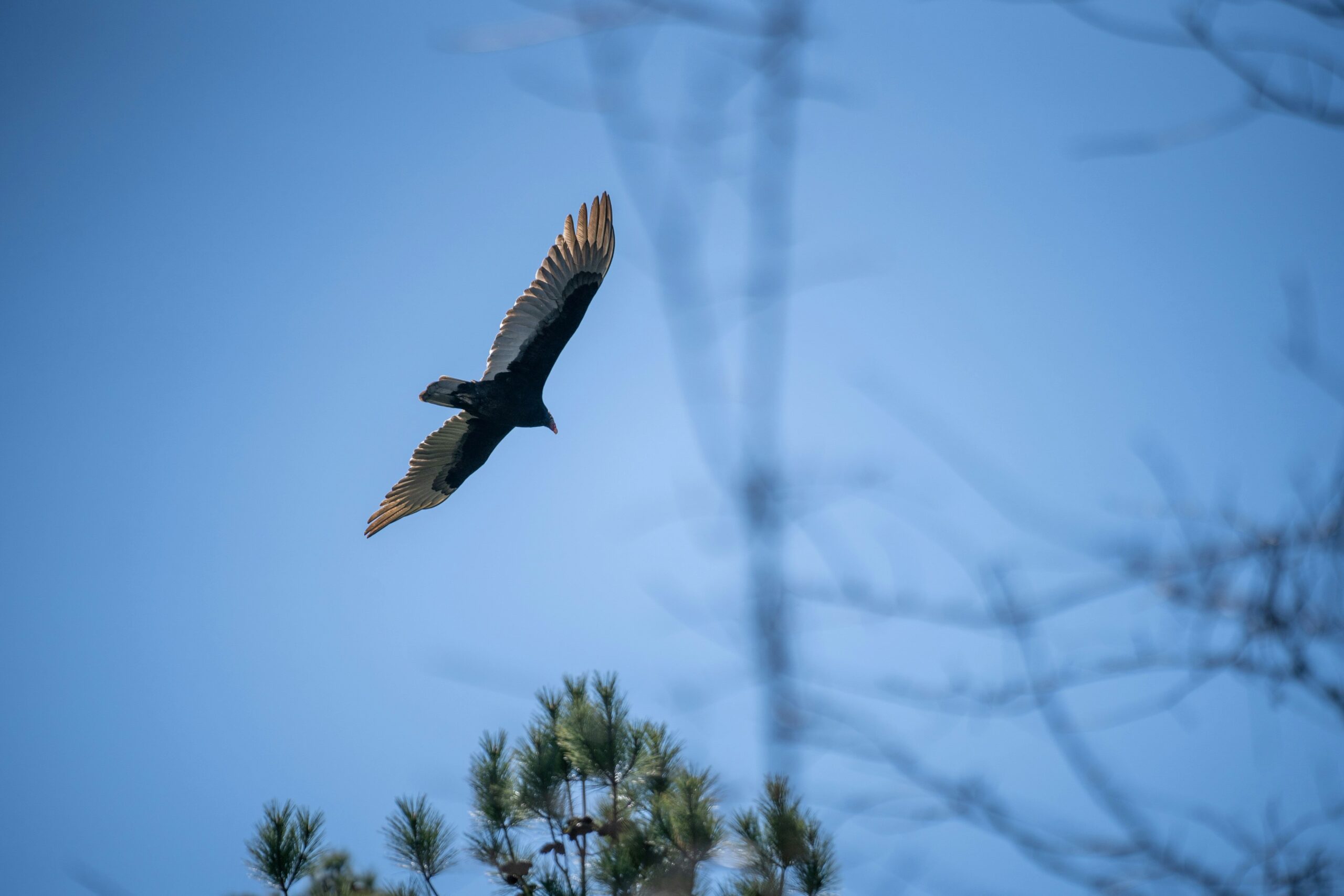
A vulture flies through the sky. A paper published in the fall explores how scientists and law enforcement could use GPS-tracked scavenger species like vultures as sentinels to monitor illegal poaching activity. [Credit: Tyler Donaghy via Unsplash | Unsplash License]
In 2019, Patricia Mateo-Tomás and her research team were studying vultures in the Northwest regions of Spain. One day while observing the birds’ feeding sites, they came across something disturbing.
As she approached the red deer carcass that the vultures were feeding on, Mateo-Tomás immediately knew “something weird has happened.” The carcass was missing its head, along with several other parts of its body. When vultures feed on red deer, “normally you’re able to differentiate the head, the bones, the skin, the different parts,” she said. Between the state of the carcass, and the location and season they found it in, they realized the animal had been illegally dismembered by a human.
That day, Mateo-Tomás and her team discovered that red deer were being poached in Northern Spain for their antlers — something that wilderness authorities didn’t even know was a problem.
The team of scientists tipped off law enforcement, who began surveilling the area for repeat signs of poaching activity. Mateo-Tomás said it’s near-impossible to catch poachers in the backcountry, but with their field observations of the vultures’ behavior as a lead, rangers patiently waited for the poacher to strike again, and then caught the suspect in the act of killing another animal.
The discovery sparked the curiosity of Mateo-Tomás and her research team, who work at sites across Europe. A new field of study gleamed ahead, and they wondered: Was it possible to use one species’ data to investigate another’s suspicious death?
“We normally use the GPS tracking to discover the threats affecting the species that you are actually tracking…not to discover the poaching of a different third species because of their interactions,” she said.
In a paper published in the fall, Mateo-Tomás and her team at the University of Oviedo in Spain — along with collaborators at Portugal’s University of Porto and Austria’s University of Veterinary Medicine — explored this question. To do so, they examined cases in which GPS data from vultures and wolves had the potential to help them expose wildlife crime.
They tagged vultures with GPS devices, and then mapped the areas where there were high counts of tagged vultures gathering at certain regions during certain times of day. Five days after confirming potential “feeding points,” the researchers would head out to the field and survey any carcasses they found for evidence of illegal trapping or poaching.
They also GPS-tagged another species of scavenger — wolves — to paint an even more complete picture of potential poaching incidents. Like vultures, wolves find and eat animals that are already dead. While vultures scout for food over areas with less tree cover, wolves tend to eat carrion in forests. “The two species are able to provide information of different types of poaching, and they complement [each other] regarding the ecosystems that they use,” Mateo-Tomás said.
This allowed the researchers to gain insight about the less-researched potential for poaching “more or less through the eyes of the animal,” said Wanja Rast, who was not involved in the research. He’s a PhD student at the Leibniz Institute for Zoo and Wildlife Research in Berlin, and studies how AI and technology can be used to understand animal behavior.
Since that first red deer, Mateo-Tomás’s team has used their same methods to track the data of vultures and wolves across Spain, Portugal, Bulgaria and the Czech Republic. They found and reported seven additional cases of deer poaching. They also discovered and directed authorities to remove a couple of snares, which are banned in hunting across most of the European Union.
Mateo-Tomás said that most people think about poaching as being in the past, or “they think elephants, rhinos or tigers in the jungles or in very wild areas — not in Europe… But what we are discovering by GPS tracking all these animals is that poaching is still present in our surroundings.”
“We have such a lack of data on wildlife crime in general,” said Audrey Chambaudet, a World Wildlife Foundation wildlife trade and crime policy expert based in Brussels. While she said this technology “is not going to be a game changer” on its own, she said it represents one more possible way that more data can help scientists pinpoint and stop episodes of wildlife crime.
“It’s a bit like nature helping fight back against wildlife crime, so there’s some sort of satisfaction with that,” she said.
Rast said this new method of wildlife surveillance “can really help to fight poaching, especially on the organized crime side,” he said. “Especially in areas where there’s not real knowledge of how prominent this is.”
However, even Rast felt conflicted about some of the unintended consequences that may arise from this new field of research. Despite the potential sentinel species have to illuminate wildlife crime, he worries about how it could put the animals at risk.
Chambaudet agreed. She said if poachers realize vultures or wolves can actually “snitch” on them, “isn’t there a risk then that then the perception of that species might be very negative, and then we would increase the persecution of [these species]?”
Rast said authorities may be more hesitant to propose sharing research like this publicly, because “we also never know how poachers would respond,” he said. Rast fears a world in which poachers retaliate against the sentinels, harming these animals to conceal their crimes.
It’s already happening in Southern Africa, where thousands of vultures have been killed in mass poisoning incidents. Sometimes, it’s accidental: The vultures may eat the poisoned meat of animals like elephants, who were hunted by poachers for their tusks. Other times, it’s tactical: Poachers have poisoned the water sources of vultures to keep them from circling in the sky, which has alerted wildlife authorities that animals were killed illegally.
Even so, Mateo-Tomás is confident that sentinel species can broaden scientists’ understanding of ecosystem interactions in the outback. That includes providing information that informs conservation policy and combats wildlife crime.
Since her team found that very first red deer in 2019, Mateo-Tomás said her research feels different. She knows that she’s not just in the field anymore — she could be at the scene of a crime. “Now we expect much more of the surroundings, and try to pay attention to absolutely anything that could be suspicious, just to get as much information as possible,” she said.
Filed To
Share
About the Author

Isabel Gil
Isabel Gil is Brooklyn-based science and health journalist. She is interested in covering creative solutions that emerge at the intersection of science and the public. She previously reported for NPR affiliates WGVU and Michigan Public, where she covered Great Lakes research, invasive species, health policy, and more.
1 Comment
Wow, what an insightful article! The use of scavenger spies to combat wildlife crime is a brilliant strategy. It reminds me of when I participated in a local conservation project; we used camera traps to monitor endangered species and gather data on poacher activity. It’s fascinating how innovative methods can lead to real change in protecting our planet’s biodiversity. This approach brings unconventional solutions to the table—kudos to those scientists!