University athletic trainers are leaving the sideline. Here’s why.
Low pay, long hours and a lack of support are leading some university athletic trainers to leave the field
Avril Silva • February 5, 2026
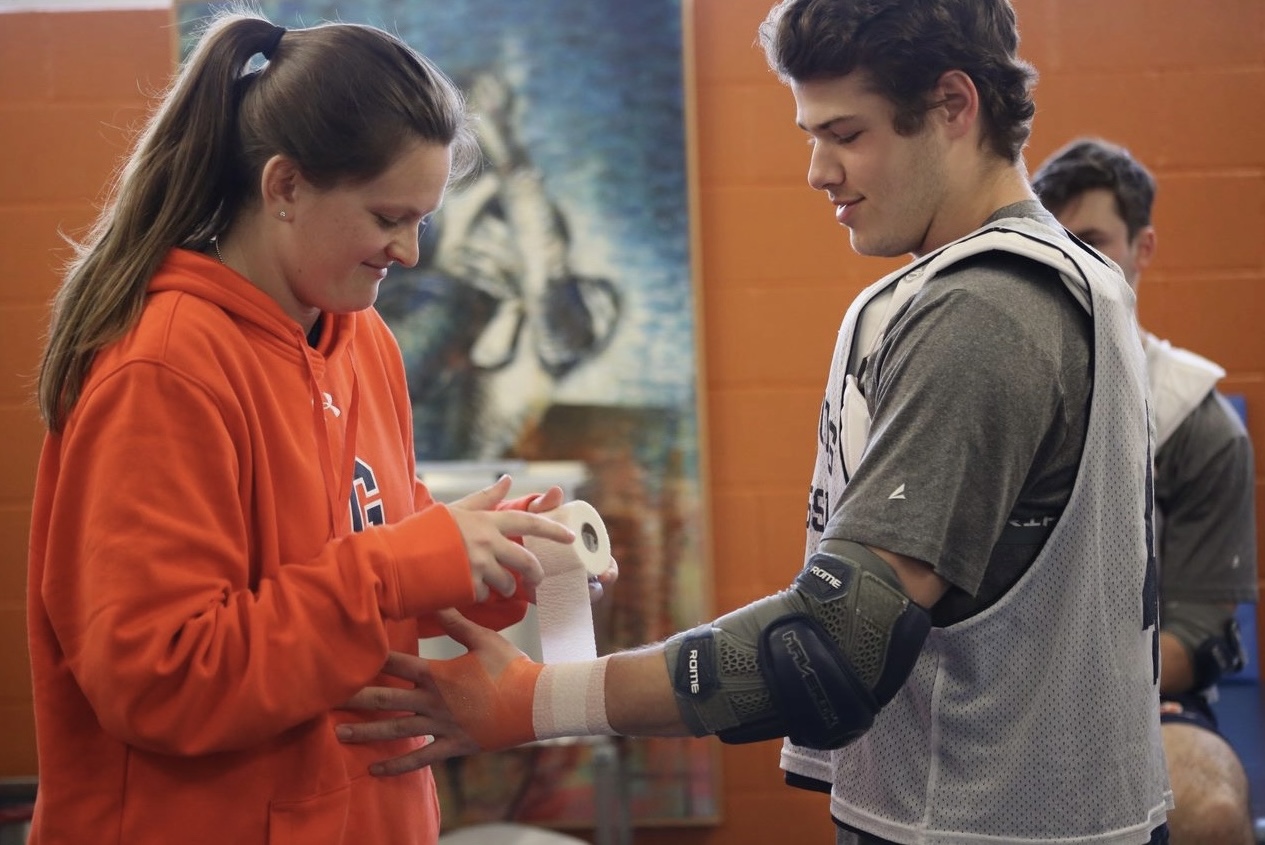
Athletic trainer Lauren Fry taping a wrist at Gettysburg College in March 2022. [Credit: Lauren Fry]
$32,000 a year for a 60-hour work week. For Lauren Pinzka, a former athletic trainer, it simply didn’t cut it anymore. Especially as she could feel herself fading away from the burnout.
“Instead of being happy-go-lucky, like I usually am, I would take my frustrations out on athletes, which I didn’t want to do. I don’t want to be that person,” said Pinzka, a former athletic trainer at Case Western Reserve University in Cleveland.
Pinzka grew up in Bucks County, Pennsylvania, outside of Philadelphia, playing soccer and lacrosse. After spraining her ankle several times and working with her own athletic trainer, she decided to become an athletic trainer to combine her two passions for sports and medicine.
But as the years passed in the profession, her mental health suffered.
“I was drowning in a way,” she said.
And so she quit.
At colleges and universities, athletic trainers are healthcare professionals that attend to student athletes from the moment an injury occurs, aiding them through the rehabilitation process, and supporting them back on the field or court. However, their pay is far below that of other rehabilitation practitioners.
The average annual salary for a university athletic trainer is $58,820, according to the Bureau of Labor Statistics. A 2024 survey of 215 athletic trainers by Colibri Healthcare found that this is nearly $38,000 less than an occupational therapist, which has similar training requirements as an athletic trainer.
On top of their board exam, athletic trainers must have a master’s degree, according to the National Athletic Trainers Association. With low wages, many athletic trainers struggle to pay the average $62,000 of student loan debt they find themselves in as they enter the industry.
Pinzka worked at an NCAA Division III college, which one study suggests has a much higher athlete to staff clinician ratio — 137.5 to one, on average — than in other NCAA divisions.
Lauren Fry, another former athletic trainer, worked at Gettysburg College, which is also a Division III school.
After leaving her post, Fry joined NovaCare Rehabilitation as their Area Director of Sports Medicine, supervising a team of athletic trainers that would serve local high schools and universities in need of extra help. Like universities, secondary schools also face staffing and retention issues, with only an estimated 35% employing a full-time athletic trainer.
One time, Fry was unable to follow the high school football team she was covering to their away game due to staffing shortages. On a September weekend during the team’s first game of the season, a teenage athlete suffered commotio cordis, a sudden hit to the chest that causes a potentially lethal heart rhythm and cardiac arrest.
An emergency medical services (EMS) team was luckily able to resuscitate the athlete, but there was no athletic trainer there to activate them as usual. Athletic trainers are typically the preferred on-site medical providers in the high school setting.
“Until more catastrophic injuries and, unfortunately, deaths happen, that’s when people are going to start waking up and saying, ‘okay, we need athletic trainers,’” Fry said.
But fewer and fewer may become available. Fry said that athletic trainers are jumping ship because of the pay, time commitment and lack of respect from school administrations, parents, coaches and even athletes.
A survey released in 2024 found that early professional athletic trainers were most at risk of leaving the field, citing low salaries and high burnout as barriers for profession retention, especially during the pandemic.
Although about 24,000 new athletic training jobs are projected over the decade, the total number of qualified athletic trainers is expected to grow by only 3,800, according to the Bureau of Labor Statistics.
Over time, Fry and Pinzka found themselves repeating the same warnings to prospective athletic training students.
“A lot of athletes would tell me that they were interested in becoming an athletic trainer, and I would talk them out of it,” Pinzka said.
Choosing passion or pay
Julie Cavallario and Caliee Welch Bacon have spent years collecting data and researching trends in the athletic training profession. In a 2024 report, they found that 15 states had average pay ranges for their athletic trainers that were lower than the minimum pre-tax livable wage necessary to reside in the state.
Welch Bacon, a research professor at A.T. Still University in Arizona, said that while salaries differ based on location and family needs, a study she conducted found that athletic trainers often also have trouble negotiating and advocating for a salary that works for them.
In any case, negotiating a better contract is sometimes not enough.
Cavallario said that athletic training salaries are measured against their setting: healthcare professionals or university faculty.
“It doesn’t do them [university athletic trainers] any favors if they are not benchmarked against other healthcare professionals,” Cavallario, an associate professor at Old Dominion University, said.
And athletic trainers at a college or university do not individually bill for their services like other healthcare professionals, according to Cavallario.
Fry also said she thinks that individuals accepting low wages just exacerbates the problem. While she once declined a job offer for $22,000, she said she expected someone to accept the position soon after.
“Until our athletic trainers stop accepting those types of jobs and start demanding more and less hours or more support help, I think that we’ll continuously see the downfalls of this career path,” Fry said.
Lack of staff is another issue
University athletic training programs follow different models of funding, but funds usually do not come from the athletic departments they serve, Cavallario said. Instead, she said they are either salaried employees at a university’s hospital and student health department or considered faculty members that have to teach on top of their work with athletes.
“It’s a wild, wild west in colleges, in terms of how the funding could be conducted, and then also how those salaries are then compared, and who they’re compared to,” Cavallario said.
Pinzka’s last employer, Case Western Reserve University, would not comment on their compensation model and their athletic training budget, but acknowledged retention issues.
“The nationwide crisis across NCAA Division I, II, and III in recruiting, hiring, and training athletic trainers has been well-documented, and the Case Western Reserve University Department of Physical Education and Athletics has certainly not been immune to it,” the department said.
Based on the National Athletic Trainers’ Association’s staffing recommendations calculator, Case Western Reserve should have been employing five more full-time athletic trainers.
Even with fewer trainers than recommended, they were never fully staffed while Pinzka was there.
“Every year I was at Case, we only had three and could never fulfill a fourth position. So already, technically, we’re understaffed, and then extra understaffed because we couldn’t get that fourth position ever filled all four years I was there,” Pinzka said.
Pinzka’s university wasn’t alone in its understaffing problem. In a 2024 survey of 215 athletic trainers, almost 46% said they felt their workplace was not efficiently staffed.
While Cavallario said there is no nationwide data yet on staffing shortages, she sees a “shortage of athletic trainers that are willing to take poorly compensated positions or positions that do not align with maybe their priorities for work life balance.” She said this shift in mentality is “long overdue.”
Cavallario said that even as her peers slowly fall out of the profession, she is hopeful about the upcoming generation of athletic trainers and their ability to advocate for the pay and work-life balance necessary to keep them in the field. “I’m very optimistic that they’re going to make some of the changes,” she said.
Filed To
Share
About the Author

Avril Silva
An award-winning journalist, Avril has experience covering environmental and public health policy and is interested in pursuing investigative journalism. You can find more of her work on CBS News, POLITICO’s E&E News, and more.
2 Comments
University athletic trainers are leaving the sidelines mainly due to low pay, long hours, and burnout from heavy workloads.
It’s not a shortage of trained professionals—it’s a shortage of people willing to stay in demanding, underpaid sideline roles.