Glacier’s iconic mountain goats are losing their foothold
With key alpine resources in flux, the species faces an uncertain future
Emma Smith • September 9, 2026
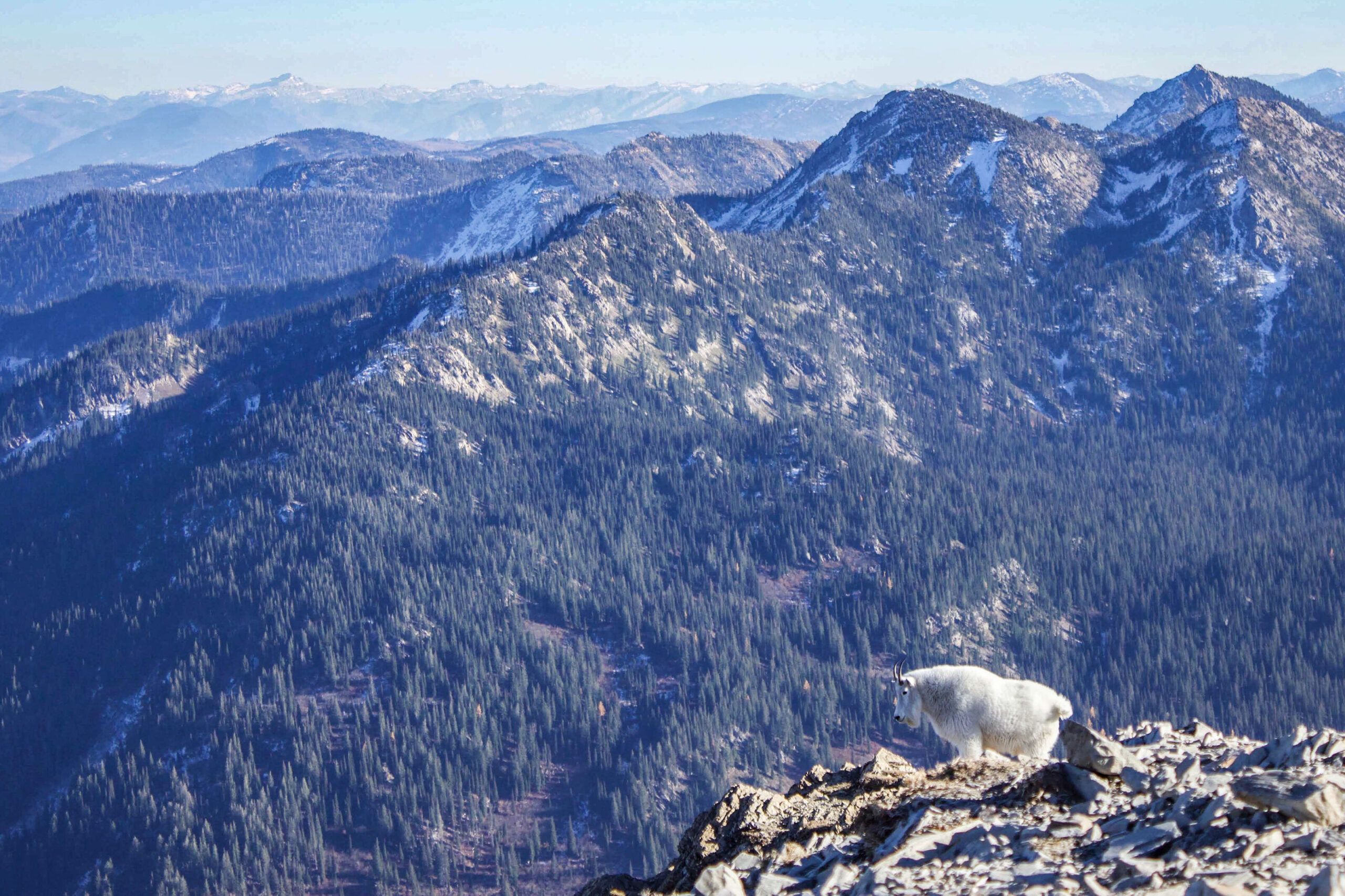
A mountain goat stands on the 7,510-foot summit of Mount Aeneas within the Swan Range of Northwest Montana, just outside of Glacier National Park in the fall of September 2018. [Credit: Emma Smith]
Driving through the west entrance of Glacier National Park in Montana, visitors are greeted by a faint etching of a mountain goat on the bottom corner of the welcome sign. The park’s makeshift mascot, known for its pristine snow-white coat and ability to traverse rocky, steep terrain, is now navigating a different kind of obstacle.
Over roughly a decade, mountain goat numbers across the study sites declined by 45 percent, from 2008 to 2019, according to a 2026 study. The decline was consistent through 2015, after which estimated numbers stabilized. The factors potentially driving this are not unique to Montana.
As temperatures rise, conditions in mountainous areas surrounding Alaska, Canada and Montana are shifting, in turn impacting mountain goats, a study in Global Ecology and Conservation found. To survive, they rely on niche assets, including snowpack, glaciers, forage and natural mineral licks, where exposed rocks create nutrient deposits. In the study, researchers found that lower precipitation levels were associated with reduced survival and limited foraging options. Currently, snowpack is low, and there is limited water available throughout northwestern Montana.
“Mountain goats are icons of these wild, alpine places. They are sensitive to changes in alpine environments,” said Kevin White, an ecologist with the University of Alaska Southeast, who was not involved in the study.
Researchers documented the decline using data collected from the High Country Citizen Science Project. Over 11 years, scientists and volunteers ventured to 37 established mountain goat sites across the park. The estimated average number of goats per site fell from about 77 in 2008 to 42 in 2019, marking a 45 percent decline over 11 years.
“We saw this pretty big decline in mountain goats over that time period,” said Tabitha Graves, a study author and research scientist with the Northern Rocky Mountain Science Center, a U.S. Geological Survey facility. “The thing is that mountain goats don’t rebound from population loss very quickly.”
They reproduce far more slowly than other animals, White says. A female typically has her first kid around age four and may produce only one kid per year. If forage is scarce, she may skip a year altogether. “It’s [a] very different life history than, say, white-tailed deer,” Graves said. They breed in the fall or winter and may have one to two babies, according to a study.
Any decline makes the mountain goat population recovery particularly difficult to manage, White says. Especially in places like Alaska, where avalanches wipe out 23 to 65 percent of all mountain goats, a 2024 study found.
Exactly what is driving the overall decline remains unclear. Researchers need more information to tease apart the factors affecting goat survival and determine how populations may recover, Graves said. Getting those answers requires funding that parks may not have or be able to use to prioritize mountain goats, as they are not the most sought out species for hunting and they live in often inaccessible terrain, according to White.
The remoteness is part of what has fascinated people who study mountain goats. Jami Belt, a biologist and citizen science program manager, said she admired “the ability of mountain goats of any age to climb and cling to precipitous cliff faces and to do so with such seemingly little effort.”
Belt and Mark Biel, Glacier’s Natural Resources Program Manager, are now working on future conservation efforts, like collecting scat samples and DNA to establish the number of mountain goats in the park. But understanding these species also means making sure visitors understand why they matter to the ecosystem.
Biel said that part of this is explaining the contribution that mountain goats make to the environment and ecosystem by grazing for forage and feeding other species in the overall alpine system food web. “We need to continue to meet with school groups, environmental groups, and other groups to help people appreciate the park’s mountain goats because when people understand a specific wildlife species better, then they want to do what they can to better protect these species,” Biel said in an email.
Filed To
Share
About the Author

Emma Smith
Emma Smith is a science journalist and adventurer based in New York City. She covers wildlife, oceans, biodiversity, conservation, and the intersection of health and humans. You can find her work in Sierra Magazine, Mongabay, the Revelator, Think Global Health, and others. She has a B.A. in journalism from the University of Montana.
6 Comments
Noticed the video where stupid tourists climbed off trail to photograph mountain goats (Montana native)
In many parks including Glacier, mountain goats were quietly being killed or removed in favor of Bighorn sheep, a more “sporting” species favored by hunters. This unpopular decision was publicly contested by visitors and residents alike but failed to deter the policy.
We love Mt.Goats &the Rocky Mts.and the West. Thanks for your good work.
Who pays for all these scientific studies. People not starting or quitting hunting leaving no money for off beat studies that go on on on for years. Better findsome other sugar daddies. Hint. Gonna be taxpaye.
Montanan here. What a shame! This is only the beginning of mass die-offs stemming from climate change. So to the republicans: go f yourselves for the denial of human caused climate change. As long as the politicians stay rich and don’t have to care this will flourish throughout nature and one day it will be us!
Mindy has no idea what she is talking about!