Taking the blame off El Niño
Climate change is blurring lines around El Niño’s impact as researchers try to demystify a powerful periodic weather pattern
Bela Silverman • October 31, 2026
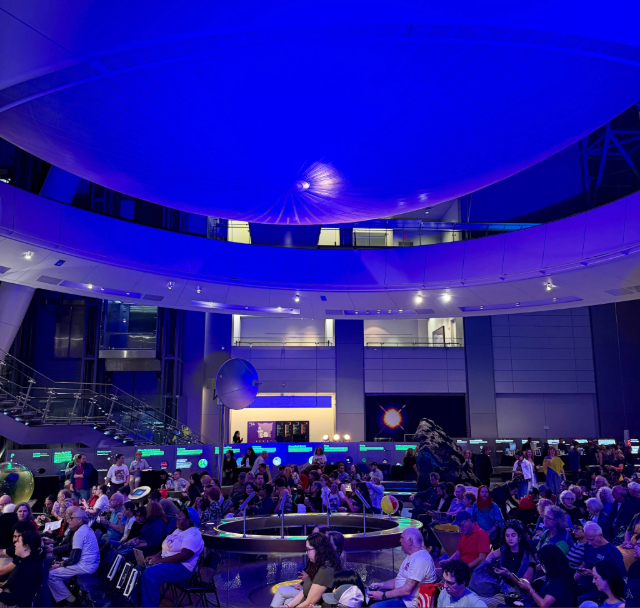
The American Museum of Natural History's SciCafe crowd — filled with researchers, students, and community members — gathered at the Hayden Planetarium for a happy-hour discussion on El Niño's impacts under climate change. [Credit: Bela Silverman]
“Even the taxidermied raccoons upstairs have heard of El Niño,” said Emily Becker, pacing the stage in the American Museum of Natural History’s planetarium.
Laughter echoed from the 200 or so people in attendance at the New York museum’s first SciCafe of the season. Many were clutching $13 “stormy mules” that sent the smell of rum wafting through the air as the DJs in the back quieted the music. What felt much more like a high school homecoming dance upon arrival — punch bowls and all — quickly turned into a science symposium, as the blue neon lights dancing across the domed ceiling coalesced into a spotlight on Becker, an expert on the powerful, periodic weather phenomenon known formally as El Niño/Southern Oscillation, which affects global climate.
El Niño has dominated weather headlines over the past few months, and this year’s super El Niño has been breaking records left and right, from sea surface temperature spikes to sea level rise and flooding. Occurring every two to seven years, El Niño forms when water warms at the equator and redistributes, shifting Pacific currents southward. While the pattern isn’t new, NOAA has placed this year’s El Niño in the “very strong” or “super” category, marked by sea surface temperatures more than 2 degrees Celsius above average.
Becker and her longtime colleague, Kris Karnauskas, both atmospheric scientists and former graduate school classmates, took the stage for a happy-hour-timed discussion aimed at demystifying common misconceptions about El Niño and its overlap with planet-wide global warming.
“A lot of reporting around El Niño makes it seem like it’s a comet that is going to hit Earth and destroy us,” said Becker, who is based at the University of Miami. “There will be extremes this winter, but there are extremes every winter. With El Niño, we know it’s going to happen because it’s a seasonal cycle.”
Becker and Karnauskas, who teaches at the University of Colorado Boulder, stressed that the relationship between climate change and El Niño is not always clear. Sometimes, the two phenomena work together to amplify a storm’s wrath, as with nor’easters — but not always.
“El Niño is certainly linked to more nor’easters,” Becker said, “But there’s an emerging picture that nor’easters are getting stronger because of El Niño, but that’s not the case. It’s due to climate change.”
She explained that while El Niño is linked to more frequent nor’easters, warmer air from climate change can hold more moisture, driving stronger storms through heavier rainfall and snowfall. In short, El Niño takes the blame for extreme weather that climate change amplifies.
For hurricanes, however, El Niño works against climate change’s warm ocean temperatures and rising sea levels. “El Niño tends to suppress hurricane development in the Atlantic. Wind shear, which is bad for hurricanes, increases, pushing away hurricanes before they can develop into hitters like Katrina or Sandy,” Karnauskas said.
Addressing the crowd’s immediate surge in raised hands, conflicted on whether or not El Niño is preventative or problematic, Becker condensed the argument, saying, “The point is, El Niño, regardless of how strong it is, is happening in the context of a much warmer world.” She explained that the pattern between El Niño and La Niña, its cooler counterpart, has gone on for millions of years.
Karnauskas concluded the event apologetically, saying there is no way to fully separate the impacts of this year’s super El Niño from our “unrelenting rise in anthropogenic emissions and warming.”
But both scientists cautioned against using El Niño as a catch-all explanation for extreme weather. “Understanding how El Niño has changed, continues to change, and how its impacts are going to be affected by global warming are critical,” Becker said.
Filed To
Share
About the Author

Bela Silverman
Bela Silverman is a science journalist based in New York City with a background in climate science. She covers issues within the realm of science, health, and the environment, with a focus on climate justice and conservation.