Beguiled by the octopus brain
Studying octopus cognition complicates and enriches our understanding of intelligence
Saskia Grisaru • November 4, 2026
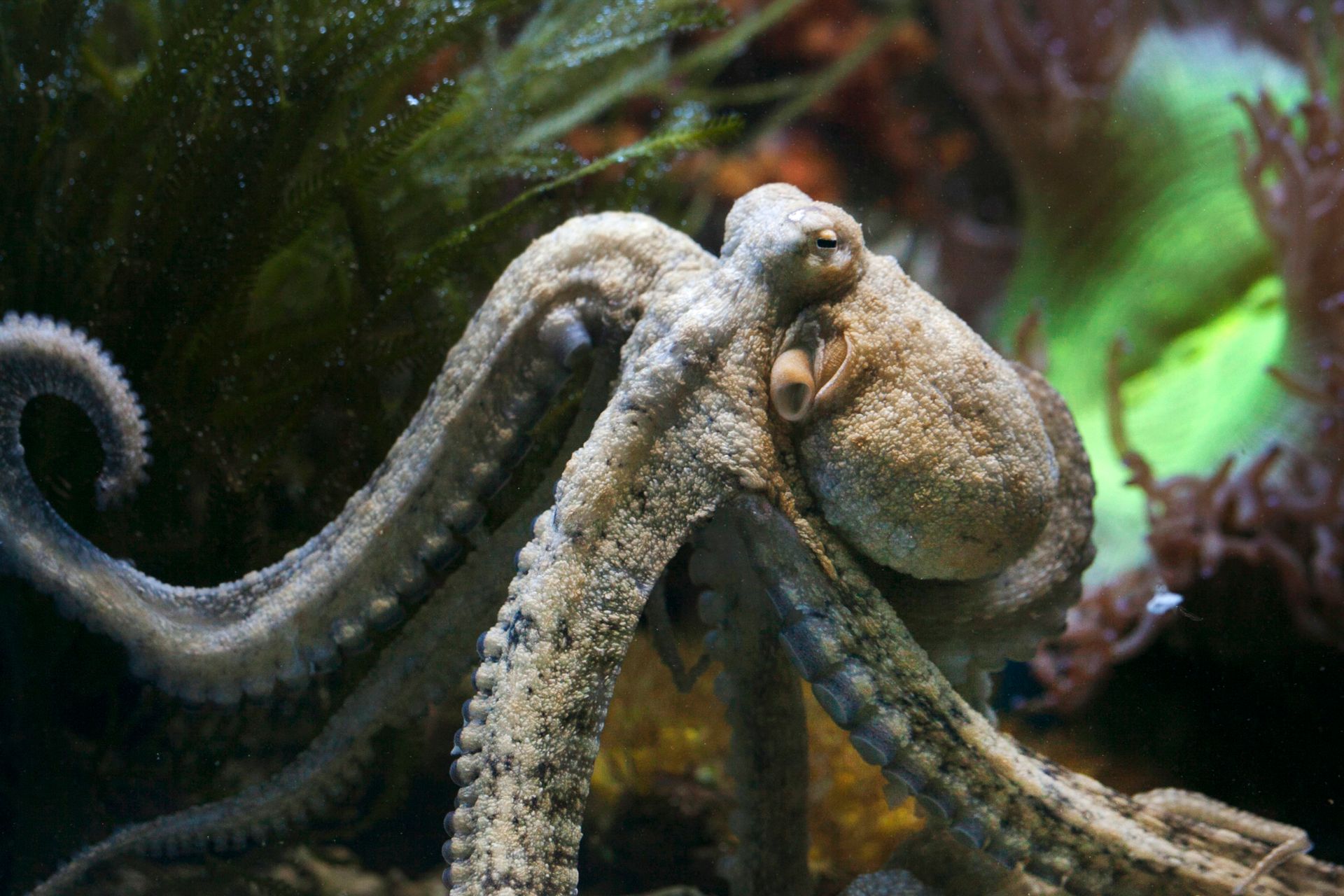
It’s a common misconception that the sac behind the octopus’s eyes holds its formidable brain; in reality, this “mantle” holds the internal organs and gills, while the central brain sits between the eyes. [Credit: Jeffry Surianto | Pexels]
Marie Kieseler had to deal with some difficult participants in her latest research project. Some only wanted to work with certain scientists, or else they would sulk petulantly and ignore the interloper. They needed to be treated as individuals with particular personalities, she decided.
Nothing unusual about that — except that Kieseler was studying octopuses.
Of all the mind-boggling facts about octopuses — the donut-shaped brains that wrap around their throats and extend into all eight arms via neural cells, their preternatural ability to change colors in seconds and squeeze through eyeball-size openings—the fact that they have individual personality traits might seem relatively tame.
But personality is a more relatable and endearing trait in a species that brings us “probably as close to studying alien cognition as we’ll get in our lifetimes,” said Kieseler, a postdoctoral researcher who studies the neuroscience of vision at the University of Fribourg in Switzerland.
Offered the opportunity to join an octopus research project while completing her PhD at Dartmouth, Kieseler jumped at the chance. The results of her study, published in June, reveal that octopuses are capable of using a mirror to understand spatial layouts and find prey. It was the first study to demonstrate this capacity in invertebrates.
That finding was just the latest confirmation of octopuses’ intelligence, a feature which is granting the animal increased time in the limelight, in books and on screens.
Their remarkable brainpower and highly developed camouflage abilities explain why an otherwise-defenseless and tasty animal, essentially a “bag of protein in the water that everyone wants to have a snack on,” has survived at least 330 million years, according to Carrie Albertin, an evolutionary biologist at Harvard and leading researcher in cephalopod genomics.
Evolutionarily speaking, Albertin explained, cephalopods—a class that includes octopuses, squids, cuttlefishes and nautiluses—are some of the most distant animals from humans, as over 550 million years have elapsed since our species diverged.
But all of those hundreds of millions of years spent evolving apart can seem to fall away quickly when humans and octopuses make contact, said Alex Schnell, a comparative animal psychologist with extensive experience in studying cephalopod cognition and behavior. “Octopuses are curious, and they want to interact with you,” she said. “It really does feel like that barrier dissolves.”
Albertin and Schnell come from different realms within cephalopod research, but spoke together as invitees at “Octopus Umwelt,” an event hosted by the non-profit cultural center Pioneer Works, in Brooklyn, on October 13. “Umwelt,” the German word for environment, has come to be used to refer to the inner sensory world and unique life experience of an animal.
The octopus’s Umwelt probably isn’t something we will ever understand fully. “I don’t know if we’ll ever know what it’s like to be an octopus,” Schnell said. But studies of their genetics, cognition and behavior can be incredibly informative regardless. “I think we have so many different lessons to learn from these animals,” Albertin said. “We’re going to learn more about ourselves in doing it.”
Octopuses can be gregarious, but they can also be taciturn; they’re solitary animals, but colonies have also been found living in “villages,” Kieseler said. In short, it’s hard to make generalizations about them.
They differ not only in terms of personality and sociability but also, in some sense, intelligence. All of the octopuses in Kieseler’s study had to learn how to use the mirror, but some caught on quicker than others.
This particular form of octopus intelligence, the capacity to learn, is more analogous to human intelligence than other ones. Nevertheless, it differs strikingly from our own learning in certain respects. Octopus parents generally die shortly after reproduction, so octopuses are “born orphans, and they have to learn everything on the fly,” said Schnell. For humans, this would be an untenable evolutionary strategy. But for Albertin and Schnell, that’s part of what makes studying these animals so fascinating. “Evolution doesn’t have one rule book,” Schnell said.
Albertin called out the work being done at the Axel Lab at Columbia in particular. There, under the direction of Tessa Montague, scientists are developing the first transgenic cephalopods. By injecting fluorescent proteins into cuttlefish brains, the researchers will be able to trace the neural pathways that light up when cephalopods think, said Connor Gibbons, Axel Lab’s facility manager, who was manning a cuttlefish table at the Pioneer Works event. In other words, we should have the clearest image yet of what’s happening inside an octopus’s brain.
“I think this will change everything,” Gibbons said.
Filed To
Share
About the Author

Saskia Grisaru
Saskia is a science journalist currently based in Brooklyn. She has a background in forestry, environmental and climate sciences, and also linguistics.