Francis Halzen awarded 2026 Nobel Prize for detecting neutrinos with Antarctic ice
Halzen is the leader of IceCube, an international collaboration that detects ghostly particles from across the universe
Maia Chandler • October 6, 2026
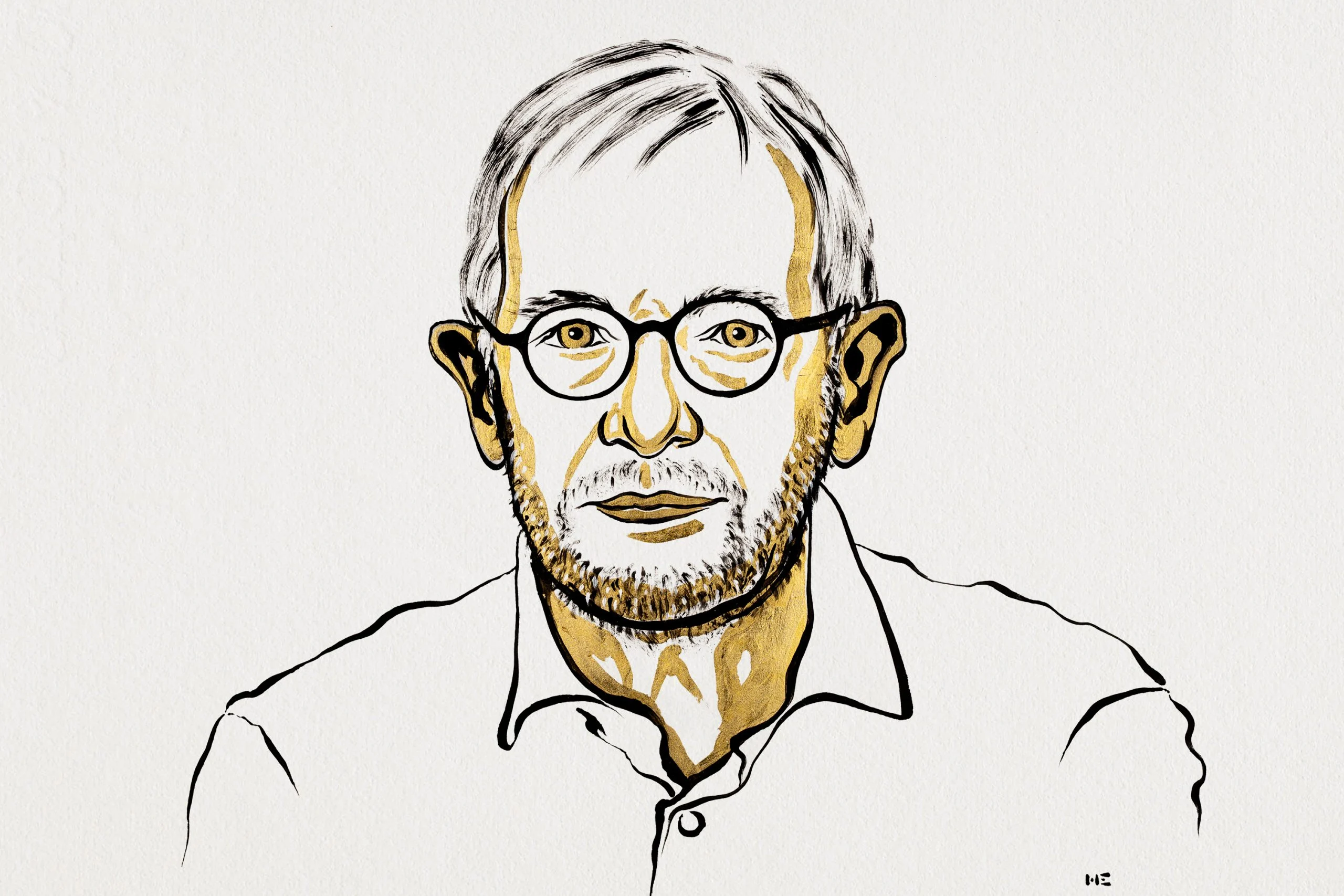
An illustration of Francis Halzen, the 2026 Nobel Prize in Physics laureate. [Credit: Niklas Elmehed © Nobel Prize Outreach]
Francis Halzen was awarded the 2026 Nobel Prize in Physics on Tuesday for pioneering the study of high-energy neutrinos.
Neutrinos are the most abundant particle in the universe. They’re produced during nuclear reactions and come from nearly everything — stars, black holes, the radioactive Earth, supernovae, the Big Bang — but interact with almost nothing. Their movement is immune to the pulls of stars, and they pass right through planets, according to a press release from the Nobel Committee.
Billions of them, emitted by the Sun, pass through the human body every second. Committee scientists said studying neutrinos could help us learn more about the otherwise invisible objects that produce them. They may also hold secrets to the building blocks of the universe.
Neutrinos can only be detected when they interact with an atomic nucleus — which rarely happens. They’re notoriously hard to pin down. “They’re so rare that if you build a detector which is one cubic kilometer in size, you register more or less one per day,” said Mark Pearce, one of three members of the Nobel Committee for Physics at the press conference announcing the award.
Sometimes, neutrinos interact with weak nuclear forces. “When it does this, the neutrino disappears, and it creates a muon,” said Pearce. Muons have an electric charge and create a blue light that detectors can pick up on, called Cherenkov radiation, when they speed through large solid materials, like expanses of ice.
In 1988, Halzen and a colleague realized that there was a place on Earth big enough, and isolated enough, to detect high-energy neutrinos: the naturally occurring ice under the South Pole.
Twenty-three years after Halzen’s epiphany, his detector was complete. They called it IceCube. It consists of 3D grids of light detectors, buried two kilometers under Antarctic ice.
By tracking how light blinks across the detectors, scientists can reconstruct a muon’s path and point back to the sky to see where the neutrino came from.
These neutrino messengers bring information from the cosmos. Understanding their origins can help us study nuclear processes in our Sun, and research why the universe developed the way it did. “They open the door to distant galaxies and tell us about the processes of exploding stars,” said Eva Olsson, a member of the Nobel Committee for Physics.
Halzen has been at the University of Wisconsin-Madison since 1971, and is now the Vilas Research Professor and Gregory Breit Distinguished Professor of Physics.
When IceCube became fully operational in 2011, nobody knew if the detector would be “large enough to discover neutrinos beyond our atmosphere from the universe,” Halzen said to the committee from Italy, in a phone call broadcast at the press conference.
But it only took two years to detect their first high-energy neutrino. “We found evidence for neutrinos coming from supermassive black holes in other galaxies, and they shine so strongly that they outshine our own galaxy,” said Halzen.
Today, IceCube is a collaboration of more than 450 scientists from 14 countries.
“IceCube now paves the way for a new type of astronomy, and a network of neutrino detectors is being established around the world,” said Pearce. Plans to build similar detectors in the oceans are underway, and “will allow us to monitor all of the sky, all of the time to study celestial sources in a completely new way,” he said.
Halzen emphasized that he is most proud of the early collaboration behind IceCube, which made the project possible. “This was kind of an adventure where success was not guaranteed,” he said. “I hope this reflects on the really courageous people who joined me in the beginning of this project, when no really respectable conservative physicist would have joined me, but many talented people did.”
He also hopes the Nobel Prize will propel his future research. “I’m working on a proposal, and I hope that this prize will help get it approved.”
Filed To
Share
About the Author

Maia Chandler
Maia is a Brooklyn-based science journalist. They have an academic background in biology and physics, and their work has appeared in Physics Today.