Near Grand Canyon National Park, a uranium mine raises fears of arsenic in the water
Arizona recently raised an arsenic limit at one monitoring well at Pinyon Plain Mine, where scientists are still trying to understand how water moves underground
Alissa de Chassey • October 14, 2026
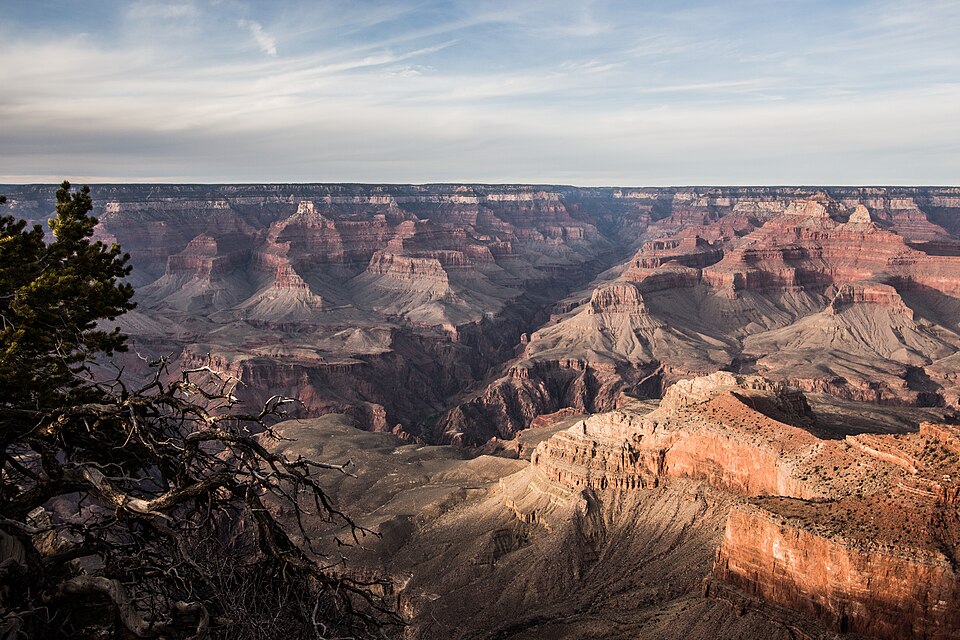
Groundwater beneath the Grand Canyon region is at the center of a decades-long debate over uranium mining and its potential impacts on the area’s water resources. [Image Credit: © Tomas Castelazo, www.tomascastelazo.com / Wikimedia Commons / CC BY-SA 3.0]
Pinyon Plain Mine, one of the highest grade uranium mines in the U.S., sits just 8.7 miles south of the Grand Canyon.
Although uranium fuels nuclear energy, a low-carbon source of electricity, what lies beneath the mine has long been a source of concern.
Concentrations of arsenic, a naturally occurring toxic element that can be released from rock when it is disturbed or exposed to changing chemical conditions during mining, have risen at one groundwater monitoring well at the mine.
Arizona regulators have responded by raising the previously acceptable arsenic limit at that monitoring well by 10 percent. On July 6, the Arizona Department of Environmental Quality (ADEQ) approved a permit amendment for the mine, increasing the Aquifer Quality Limit for arsenic at one monitoring well from 0.050 mg/L to 0.055 mg/L. ADEQ told Scienceline by email that the amendment does not authorize the mine to discharge additional arsenic into groundwater. Instead, it changes the concentration of arsenic that is considered acceptable at a single monitoring well.
The lives and cultures of Indigenous communities around the Grand Canyon are deeply connected to the region’s groundwater and springs. For them, groundwater isn’t just drinking water – it supports agriculture and cultural practices.
In a statement on July 6, one of the tribes criticized ADEQ’s decision. The Havasupai Tribal Council said the agency had “knowingly chosen to lower the bar for pollution rather than raise the standard for protecting Arizona groundwater.”
“For the Havasupai Tribe, Havasu Creek is our only permanent source of water and the heart of our culture, homeland, economy, and identity,” the council said.
In a more recent press release, on September 25, the Havasupai Tribal Council said that they have “consistently asked a simple question: Why should ADEQ allow arsenic levels to rise higher before requiring monitoring, investigation, and action?”
“Any diminishment of the springs, its quantity or quality, really impacts a cultural identity and a historical idea of who these people are,” says David Kreamer, emeritus professor of hydrology at the University of Nevada, Las Vegas. Pinyon Plain Mine is owned and operated by Energy Fuels Resources Inc. (EFRI), a wholly owned U.S. subsidiary of Canadian company Energy Fuels Inc. EFRI, did not respond to Scienceline’s request for comment.
Although the higher limit at Pinyon Plain does not apply to drinking water, but rather a site-specific threshold used by ADEQ to monitor groundwater quality at that well, scientists and communities are worried.
The agency has presented evidence that water is being drawn toward the mine, but it does not establish where the elevated arsenic originates or rule out the possibility that mining activities are releasing naturally occurring arsenic from the surrounding rock.
Long-term exposure to arsenic in drinking water is associated with cancers of the skin, lung and bladder, among other health effects, according to the Environmental Protection Agency (EPA). The federal drinking-water standard for arsenic is 0.010 mg/L.
And data from a nearby U.S. Geological Survey (USGS) monitoring well seem to complicate ADEQ’s explanation that the elevated arsenic originates in surrounding groundwater.
The well, installed in 2017 just outside the mine, monitors the same shallow groundwater system and has recorded low arsenic concentrations that declined between 2017 and 2025, according to Kimberly Beisner, a hydrologist with the USGS New Mexico Water Science Center. In other words, while arsenic concentrations have risen in the mine’s monitoring well, they have fallen in a nearby well monitoring the same aquifer.
“If arsenic is lower outside, how can that be raising the arsenic inside when it’s pumped from the outside?” Kreamer says. USGS has also collected data since 2003 from another well next to the mine that reaches the much deeper Redwall-Muav aquifer. Concentrations of trace elements there have remained “very stable,” Beisner says.
Kreamer says ADEQ’s explanation is unconvincing. He says he asked the agency for the scientific report supporting its conclusion but did not receive EFRI’s data. He offers another possible explanation: mining itself may be mobilizing naturally occurring arsenic. Fracturing rock increases the surface area exposed to groundwater, he says, while oxygen introduced during mining can alter geochemical conditions and release arsenic previously bound in the rock, in a solid form.
Kreamer says ADEQ has not quantified how much those processes could contribute to the elevated arsenic. In a meeting on September 17 with the agency, Kreamer raised his concerns, but ADEQ did not provide additional evidence or counterarguments in response.
The uncertainty is compounded by the limited monitoring of the deeper aquifer near the mine. Deep monitoring wells are extremely expensive to drill and pump. Near the mine, USGS monitors the deeper aquifer from just one well.
Beyond the source of the arsenic, another concern is whether contaminated groundwater could eventually reach the deeper aquifer.
Kreamer argues that ADEQ’s explanation assumes groundwater moves through the area in a relatively predictable way. “The data is based on a false assumption that the upper aquifer is homogeneous and isotropic,” he says, referring to the assumption that groundwater moves through material with similar properties in all directions. “With fractured rock flow and more than 17.5 miles of exploratory boreholes in all directions, this simplified view is not only false and misleading, it’s also dangerous.”
In reality, Kreamer and other researchers say water can find less predictable routes through cracks and other openings in the rock, sometimes moving between shallower and deeper groundwater systems. “There are faults and fractures throughout the canyon, and we know that water gets from the surface from the upper level down to the deeper aquifer,” says Laura Crossey, a geochemist and distinguished professor emerita at the University of New Mexico.
That connectivity raises concerns that contaminants mobilized in the upper aquifer could eventually reach deeper groundwater. But scientists have not detected an increase in arsenic in the deep monitoring well, nor have they established a direct pathway from Pinyon Plain Mine to a particular Grand Canyon spring.
“It’s difficult to study groundwater in a place that does not have many wells,” says Crossey.
Filed To
Share
About the Author

Alissa de Chassey
Alissa de Chassey is a French science journalist based in New York City. She previously worked for Le Figaro and covers biology, health, and AI.