Vaping is less harmful than smoking, experts say. Why don’t smokers know this?
Some scientists think anti-vaping public health messaging has failed current smokers
Georgia Michelman • February 20, 2026
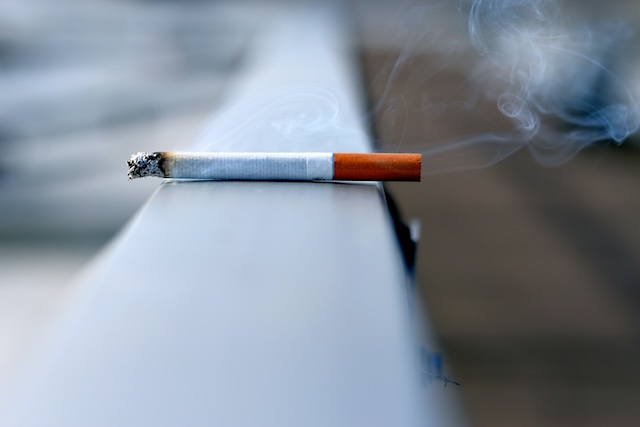
A cigarette burning. Combustion is to blame for many of the health harms associated with smoking. [Image Credit: Andres Siimon via Unsplash]
In 2018, the FDA launched a new public health campaign. “There’s an epidemic spreading,” began one ad. Wormlike creatures slithered under children’s skin, to their brain, through the bloodstream, in and out of their lungs. But this was “not a parasite, not a virus, not an infection.” It was vaping. The conversation around e-cigarettes was changing, and fast.
Throughout the 2010s, the FDA had been focusing on tobacco harm reduction. Encouraging smokers to switch to lower-risk nicotine products — like e-cigarettes — was a key part of the plan.
But with kids unexpectedly flocking to vapes in droves, public health messaging dramatically shifted.
Anti-vaping campaigns led by the government and non-profits may have been effective at getting kids to drop vapes: The proportion of middle and high schoolers who reported vaping within the past 30 days has plummeted, from 20% in 2019 to 5.9% in 2024.
Yet, some tobacco control experts think that we may have taken the scare tactics too far. In the fog of the youth vaping war, some anti-vaping rhetoric dominating the public sphere verged on untruthful, they say.
Today, many American smokers are confused about the relative risks of vaping and smoking. For people who already smoke — a different group than teenagers going straight to e-cigarettes — experts say the evidence is clear: vaping is less harmful than smoking.
But lasting misperceptions could inhibit smokers from making the switch to vapes, according to David Abrams, a professor of social and behavioral science at New York University and a leading advocate for tobacco harm reduction.
“The misinformation, in some ways, is tantamount to murder,” said Abrams. “You are telling 13 million adult smokers: don’t switch [to vaping] if you can’t quit, which leads to the statement, ‘either quit everything or die.’”
The two sides of vaping
Quitting smoking is difficult, and scientists say our current nicotine-replacement therapy options, like patches and gum, aren’t cutting it. But over the past decade, evidence has been accumulating on a potentially better method: e-cigarettes.
In 2025, a Cochrane review consolidated evidence from 104 studies and concluded that switching to vaping was the most effective way to quit smoking, for at least six months, compared to other methods.
Only 6% of smokers successfully quit using patches, gum and lozenges, the research indicated. But up to twice as many successfully stopped when using e-cigarettes. Tobacco control experts say this is a big step.
Vaping “appeals to smokers at a level we just haven’t seen for other quit aids,” said Jamie Brown, a professor of behavioral science and Director of Tobacco and Alcohol Research Group at University College London.
Still, vaping can be addictive, and it’s not risk-free.
Dependence on vapes may be distressing, said Megan Piper, a professor at the University of Wisconsin Center for Tobacco Research and Intervention. “People can feel like they have completely lost control, like they are vaping all the time. They’re spending a ton of money they don’t want to be spending.”
Piper is also concerned about potential vaping-related respiratory issues. She pointed to one study that found an increased risk of chronic obstructive pulmonary disease (COPD), a progressive incurable lung disease, in vapers. People vaping were more likely to develop it compared to people who don’t vape or smoke. (Smoking is often referred to as a primary cause of COPD.)
Finally, long-term effects of vaping are still hazy. Not enough time has passed, and not enough high-quality studies have been done to know the full extent of vaping’s impact on health. It may be the case, for example, that some kinds of vapes are more harmful than others, with budding concerns over a few chemicals in specific e-liquid flavors.
Former smokers often stay hooked on vaping once they’ve switched, compared to other nicotine-replacement therapies, said Sarah Jackson, a principal research fellow in the same research group as Brown. They don’t appear to take in more nicotine, however — vaping more frequently is not an indication one’s nicotine dependence has worsened, she said.
Smoking is far riskier, even without long-term data on vaping
So is swapping one nicotine habit for another really much better, if ex-smokers become reliant on vapes instead? The answer in experts like Brown and Jackson’s eyes is an emphatic yes. “The key thing is the comparison to smoking,” said Jackson: Vaping risks dwarf in comparison to the health harms caused by smoking. For smokers who can’t quit nicotine, switching to vaping could save people’s lives.
This is because vaping heats a nicotine-containing liquid rather than burning tobacco. By avoiding combustion, vaping does not produce many of the carcinogens present in tobacco smoke, like tar and carbon monoxide. Beyond just nicotine, “smoking is uniquely harmful because of all the other things it delivers to you,” said Brown.
This is something Americans misunderstand. Nicotine affects the cardiovascular system, and may pose harm to unborn fetuses, but it doesn’t cause the chronic diseases associated with cigarette smoking. “Nicotine doesn’t cause cancer and nicotine doesn’t cause heart disease,” Piper said. “That’s what the byproducts of combusted tobacco are related to.”
Even taking into account other chemicals in e-cigarettes, “vaping poses only a small fraction of the risks of smoking,” according to a 2022 report commissioned by the U.K.’s public health authorities.
The research reviewed suggests vapers are exposed to far lower levels of most toxicants than smokers. According to Brown, biomarkers in the body that indicate future disease also appear lower in vapers. “We can be quite confident we’re not going to get the same sorts of [disease risk] that we see for smoking,” said Brown.
Therefore, scientists believe swapping cigarettes for vapes means drastically reducing former smokers’ risks of lung disease, heart disease and cancers.
Still, smokers are increasingly misinformed about the relative risks of vaping and smoking. Jackson’s research in England found that from 2014 to 2025, the amount of smokers who think vaping is less harmful than smoking fell from 44.4% to 18.7%. In the U.S., a study using 2021 survey data found that even fewer smokers — only 12.3% — thought vaping was less harmful.
Public health messaging got complicated
In an ideal world, only ex-smokers would vape, and non-smokers would never start, Piper said. This has proven a challenging message to convey, especially as the government shifted the focus of its public health messaging to eliminating youth vaping.
When flavored vapes like Juul took off among teens, Mitch Zeller was the Director of the FDA’s Center for Tobacco Products, and sympathetic to the harm reduction philosophy. But he said he had a “holy shit reaction” when e-cigarette usage increased by 78% among adolescents between 2017 and 2018.
He said these data opened his team’s eyes to the “likelihood of unintended consequences” that came with widespread e-cigarette availability that was too appealing to teenagers.
Part of the problem was that adolescents did not seem to think e-cigarettes carried any risks. Zeller said a “sizable” amount of kids did not even know there was nicotine in vapes.
Reducing teenage vaping became a “programmatic priority” for the FDA, Zeller said. They launched their anti-youth vaping campaign in 2018, with paid ads like the nicotine worms video. Anti-vaping non-profits also began cropping up. And media coverage of the harms of vaping exploded.
An “unfortunate byproduct of [the FDA’s] excellent campaign” was its perpetuation of the idea that nicotine is the dangerous aspect of tobacco products, Piper said. “I still can see in my head the visuals of the chemicals crawling under the kids’ skin,” she said, referring to the 2018 ad.
Media coverage of vaping played a role in the confusion about relative harms, as well as emerging non-profits like Parents Against Vaping E-Cigarettes, said Mark Gottlieb, a public health and research attorney working in tobacco control. So did the government’s shift in stance on vaping. “It was implied by some health authorities in the United States that vaping is just as bad as smoking,” said Gottlieb. “And that is not true.”
Zeller said that the youth prevention ads paid for by the FDA were targeted at children, not adults. “We tried to minimize spillover” to adult viewers, he said. “We were addressing misperceptions of nicotine that we knew that kids were harboring back then, and it takes ads like that to grab their attention.”
Then, in 2019, came the EVALI outbreak — a series of lung injuries linked to vaping — which caused splashy headlines as officials rushed to investigate what was happening.
By February 2020, EVALI had caused 2,807 hospitalizations, including 68 deaths. But investigations by the FDA found EVALI was primarily associated with illegally sold marijuana vapes containing the thickening agent vitamin E acetate, rather than nicotine vapes.
Abrams says this was not made clear. He argues that the CDC, the FDA and some anti-vaping advocates played into the scare, and did not adequately communicate that the cases were not caused by nicotine vapes.
The CDC and FDA diverged on messaging on this issue, Zeller said. Under his leadership, the FDA made a statement emphasizing the connection between EVALI and marijuana vapes, and the safety of nicotine vapes. “It is a matter of public record that the CDC was in a different place,” he said.
Still, Abrams believes concern over teen vaping combined with a lack of clarity during the EVALI episode has caused lingering skepticism of vaping for smoking cessation. “I think all of that still sticks in many people’s minds as a reasonable way to be very skeptical of vaping and to not endorse it at all,” he said.
Is there a future for “healthy” vaping?
Though vapes carry fewer risks than cigarettes, U.S. regulatory law dictates that the likelihood of unintended groups using products be considered, Zeller said. He emphasized how difficult weighing up risks and benefits of wide availability of e-cigarettes can be.
Gottlieb, who leads Northeastern Law’s Public Health Advocacy Institute, hopes to reach a “middle ground” where vapes are available, but not at convenience stores or in fruity flavors that attract teen users.
Still, vapes work better than any other method of smoking cessation, Abrams said, and it’s a problem that smokers don’t know this. While he understands the desire to avoid teens getting hooked on nicotine in any form, “I don’t think that that’s legitimate ethically or morally…to distort the science in order to achieve that political goal,” he said.
After the youth vaping campaign, the FDA began work on another public education campaign, this time aimed at adults. Zeller had been long frustrated about public misperceptions around nicotine safety — in particular, the belief that nicotine causes cancer, which even many doctors and nurses believe. He said he believed that clearing up this confusion would pave the way for “a more sensible debate” on the role of vaping in tobacco harm reduction.
But by the time Zeller retired from the FDA in 2022, multiple rounds of research into effective messaging techniques had fallen flat. “The ideas that we had come up with were not adequately addressing the misperceptions [of nicotine],” he said. “And that’s where things were left.” The campaign hasn’t yet materialized.
Filed To
Share
About the Author

Georgia Michelman
Georgia is a New York-based science and health journalist. She has an academic background in physics and astronomy, but also has strong interests in controversial health stories.
4 Comments
The anti vaping camping demonstrates the significant influence of the media, but transparency is needed so that smokers understand the risks correctly, avoiding the debate turning into an emotional confrontation.
The anti-vaping group shows how powerful the media is, but honesty is key to helping smokers weigh the risks and keeping the discussion from getting heated.
this really helped me with MY rehab :)
The FDA’s 2018 nicotine-worm ads scared teens, but David Abrams’ claim that vaping misinformation is “tantamount to murder” feels extreme; still, confusing adult smokers about relative risks seems counterproductive.