National park rangers have a mental health problem. Could it get worse?
New directives and staffing cuts are compounding longstanding stressors facing National Park Service rangers
Sam Nichols • September 18, 2026
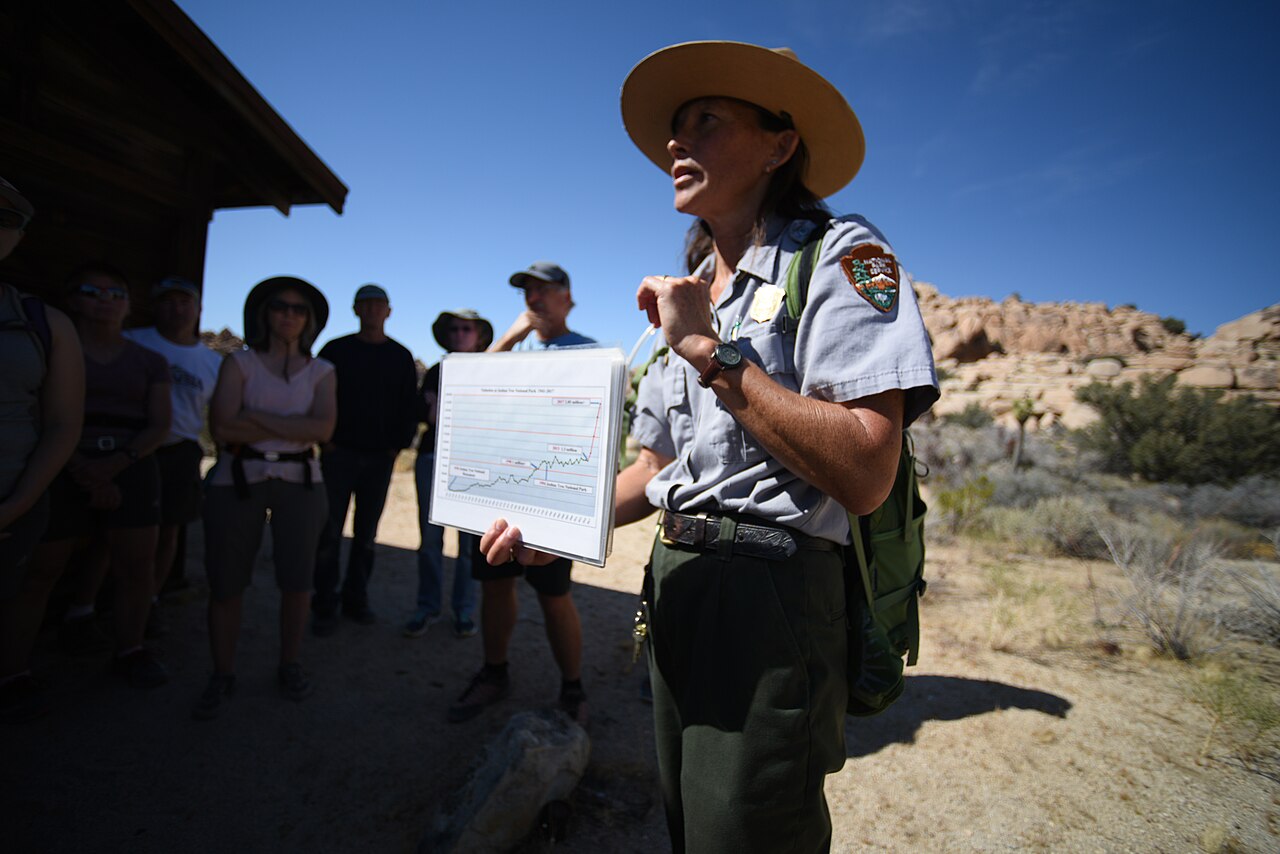
Park rangers are tasked with a ride range of duties, including assisting and educating the public. [Credit: Jesmira Bonoan/NPS | Public Domain]
Last May, Jace Ritchey, a ranger with the Muir Woods National Monument, handed in their resignation because the job that was a dream for almost six years now felt unsafe.
Being a ranger with the National Park Service (NPS) had always been physically and emotionally demanding, the 30-year-old said. During their tenure throughout Colorado and Northern California, entire days were spent delivering lectures to hundreds of visitors, patrolling miles and miles of open land or springing into action to provide life-saving care. Outside of the belittling managers and a colleague fired for reporting sexual harassment, Ritchey, during their three years as a seasonal ranger, also briefly lived inside their car. “It’s not all a walk in the park,” they said.
Still, the opportunity to work in conservation outweighed those tribulations. But since the second Trump administration began, the NPS has become a more antagonistic workplace, Ritchey said. Jobs are less secure now. In 2025, around a quarter of the park service’s permanent workforce was cut. Ritchey’s position, which they held for two years, was initially included in those mass layoffs, until it suddenly wasn’t. Those rangers that remain have been reassigned across the country with no explanation and instructed to withhold information, like deaths or references to slavery, from the public.
This new, unrecognizable landscape began to weigh on NPS employees, Ritchey said, including themselves. “It devastates me that I am leaving my colleagues behind in this, but it was making me a worse person to stay.”
But these directives have also begun compounding the many psychological strains national park rangers already face. One current ranger at a small park in the midwest, who declined to provide their name and where they work out of fears of retaliation, said the role itself, combined with regular verbal harassment from visitors, has devastated their mental health. “I am really trying to figure out how to navigate my life because of it.”
This has worsened under the current administration, this ranger said. The workforce is now smaller, while management feels more oppressive. “We have been operating with significantly less resources and staff, and doing so much more,” they said. “Not that I need to be thanked, because I feel grateful for what I do, but it has created such a tense, uncomfortable environment at work.”
Both the Department of the Interior and the NPS did not respond to questions regarding these claims about working conditions and ranger wellbeing. However, research does suggest aspects of the conservation industry, including law enforcement and seasonal contracts, can be mentally and emotionally harmful. A 2022 survey of 346 state rangers found those required to undergo more policing duties reported heightened levels of stress. It’s also been reported that burnout, precarious employment and threats of violence risk the wellbeing of rangers globally.
Few studies have documented the mental health of national park rangers, but those that exist have reached similar findings. Among 79 rangers interviewed in 2025, close to half said they were either moderately or chronically stressed because of their occupations. One of the driving factors for that distress was understaffing, said Elizabeth Himschoot, a postdoc researcher at Penn State and the 2025 dissertation’s author, with rangers often required to work outside their official positions. “They are educators. They are hospitality. They are search and rescue. They are maintenance and caretakers.”
Less staff will likely intensify this, Himschoot believes. It’s estimated there’s now around 16,000 people employed by the NPS full-time — close to 4,000 short of what was reported in 2017. “I do think it’s going to exaggerate the stressors,” she said.
Other hazards exist, though, Himschoot explained. During her research, where she surveyed 166 current and retired rangers, many expressed that, while they are devoted to what they do, the constant risk of danger, from wildlife to accidents on patrol, is mentally taxing. Parks are also large and often isolated spaces, meaning access to amenities, or switching off, can be difficult. That’s even harder for rangers living on-site, Himschoot said. “You never fully take your hat off, and you can never fully take a step back from that work stress.”
Beyond job insecurity, demanding work and harassment, Ritchey said rangers are also regularly exposed to death. During their first three weeks as a seasonal hire with Rocky Mountain National Park, an elderly woman almost died after falling and puncturing her lung. “The number of rangers I know who have been responding to a person who’s taken a fall and died or had a friend go out on patrol and died — it feels like everyone’s like one degree removed.”
These burdens can, over time, become a struggle to bear. In 2015, Rich Eshenaur, then a ranger of the Indiana Dunes National Park, almost took his life, in part because of his work. Despite finding fulfillment as a ranger, the now-retired 54-year-old was routinely threatened. Once, a park visitor fractured his jaw. He also hasn’t forgotten what it felt like to carry the body of a child who’d drowned in Lake Michigan. Or, how it was to read the notes left by those who died by suicide within the park. “I don’t care what job you’re in or how strong you are, it takes its toll,” he said. “And it took its toll on me in a lot of ways.”
Mental health resources do exist for national park rangers, but these services, according to current and former staff, including Eshenaur, are lackluster at best. “Most folks have a health plan, as part of the benefit of their employment,” said Paul Labovitz, a former superintendent of Indiana Dunes National Park who is now retired. “But I’ll be honest with you, they’re fairly worthless.”
Eshenaur’s breaking point, though, came from the NPS itself. Upper management, he said, were unsympathetic and unsupportive, while the work environment itself was hostile. “It’s not the stress from the job that puts rangers in a mental health crisis,” he said. “It’s the agency itself.”
The NPS has historically been among the lowest ranked agencies for employee satisfaction, with a key driver appearing to be poor management. A 2023 dissertation also concluded that, after interviewing 183 rangers, many didn’t feel supported by their organization. Another survey of more than 1,200 NPS employees, which the agency allegedly attempted to bury in 2018, reported bullying as common. A 2000 report also suggested most female NPS staff had been sexually harassed or faced gender discrimination. This was still a problem in 2016, according to a High Country News investigation.
The NPS did not respond to questions regarding suggestions of a toxic workplace culture, but this has long been a problem, said Cheryl Schreier, the chair of the Coalition to Protect America’s National Parks and a former superintendent of the Mount Rushmore National Memorial. This has worsened over the second Trump administration, she said. “I don’t think a lot of good discussion is happening, and that also includes support systems.”
The executive leadership is less transparent about decisions related to the NPS and its employees, she said. Those workers are also more reluctant to seek help internally, discuss working conditions with management or speak out publicly, including to her. The fear, whether real or otherwise, is they’ll be replaced if they do. “There are serious feelings of that retaliation,” Schreier said.
Like Schreier, Bill Wade, the executive director of the non-profit Association for National Park Rangers (ANPR), has struggled to connect with current staffers. “If I were to approach them and ask them questions, they’re not going to even tell me, because of that fear,” he said.
Rangers are invested in what they do, Wade said, but less support and fewer staff will likely make it harder for anyone to complete the work they’re so passionate about. “It’s not a really good time to be an employee in the NPS right now,” he said. “And these things keep coming down the line, just one after another.”
Jace Ritchey, who officially turned in their badge on September 5, is confident their former colleagues will find ways to carry on. But they’re also concerned about their wellbeing. “I’m worried about rangers,” they said, “because I don’t think that the NPS is safe.”
Editor’s note: This story has been updated to reflect that Jace Ritchey’s anecdote of an elderly woman almost dying while visiting a national park occurred in the Rocky Mountain National Park, not Yosemite National Park as originally stated.
Filed To
Share
About the Author

Sam Nichols
Sam Nichols is an Australian writer and journalist. His work, which often covers healthcare, drug policy, addiction medicine and technology, has appeared in the Australian Broadcasting Corporation, SBS and VICE.