Financial pressures threaten a vital air monitoring network in national parks
Funding for the IMPROVE project has long been stagnant, and recent years have forced cuts to air visibility tracking
Georgia Michelman • September 16, 2026
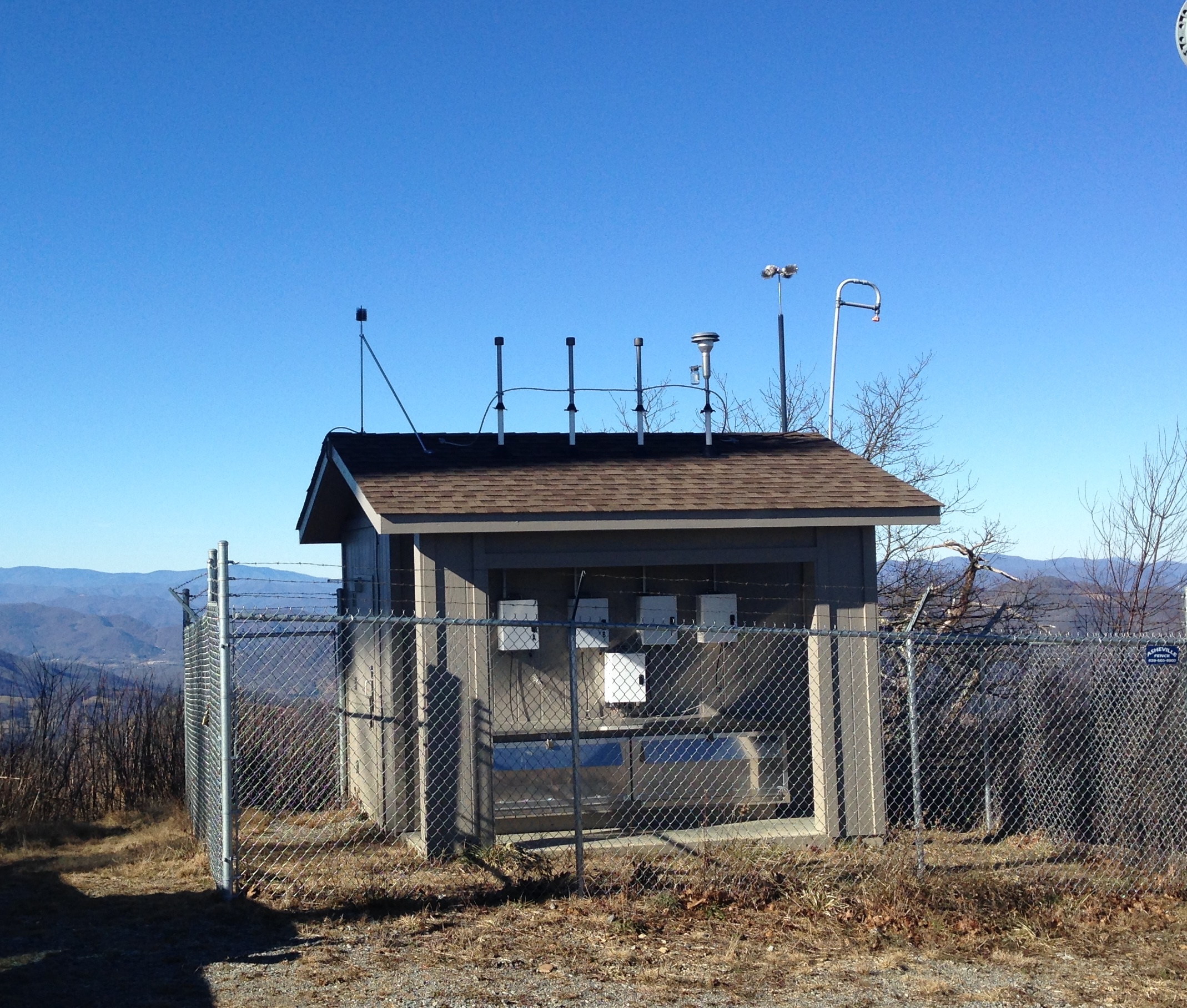
This air visibility monitor in Shining Rock, North Carolina, is part of IMPROVE’s network of 110 air samplers located in national parks and forests across the country. The program is now cutting the frequency of data collection at some monitors, and several sites have been indefinitely closed. [Credit: Scott Copeland]
Twice a week, IMPROVE site operators drive, hike or cross-country ski out to 110 remote locations across the U.S. in pursuit of dirty air.
They’ve come to collect samples from the air monitors that make up the Interagency Monitoring of Protected Visual Environments (IMPROVE) network, which tracks air visibility across 156 national parks and forests.
By the time of the intrepid worker’s visit, IMPROVE air filters are packed with a day’s worth of molecules, carrying traces of dust, hazy wildfires or pollution that’s swept in from a nearby city. After collection, the filters are sent to the lab for analysis, producing data which is used to track states’ progress in cleaning up air visibility throughout these Class I protected environmental sites.
Keeping these crucial air samplers running, though, is no easy feat. The operators are also often tasked with the messy work of maintenance: troubleshooting electrical issues, repairing a termite-devoured shelter or shooing away nosy animals.
All of this work –– from air collection to analysis to maintenance –– requires resources that IMPROVE’s stagnant budget increasingly can’t provide.
As a result, the program is now sacrificing data to cut costs. Several air monitoring sites have been indefinitely shuttered, and a significant chunk of others are decreasing the frequency of air sample collection. Overall data quality is unlikely to suffer just yet, leaders say, but without additional funding, this problem will only worsen.
Over the past several decades, IMPROVE –– which is run collaboratively by several universities and governmental organizations, including the National Park Service and the Environmental Protection Agency –– has tracked stark improvements in air quality across the country. From 2000 to 2021, the amount of PM2.5 (tiny polluting particles) across IMPROVE sites decreased by an average of 1.8% per year.
But despite these air monitors’ vital work, the program’s budget has hardly risen since 2000, hovering around $5.5 million. This “relatively flat” funding received a one-time boost of 3% in 2017, according to Bret Schichtel, the current chair of IMPROVE’s steering committee.
As time has gone on, operating costs and overall inflation have sprinted ahead of the static budget. This has become a serious issue in the past five years, said Anthony Wexler, the director of UC Davis’s Air Quality Research Center, which operates the IMPROVE network in national parks. “It’s nothing to do with the Trump administration,” Wexler said. “It’s been a problem that’s been growing.”
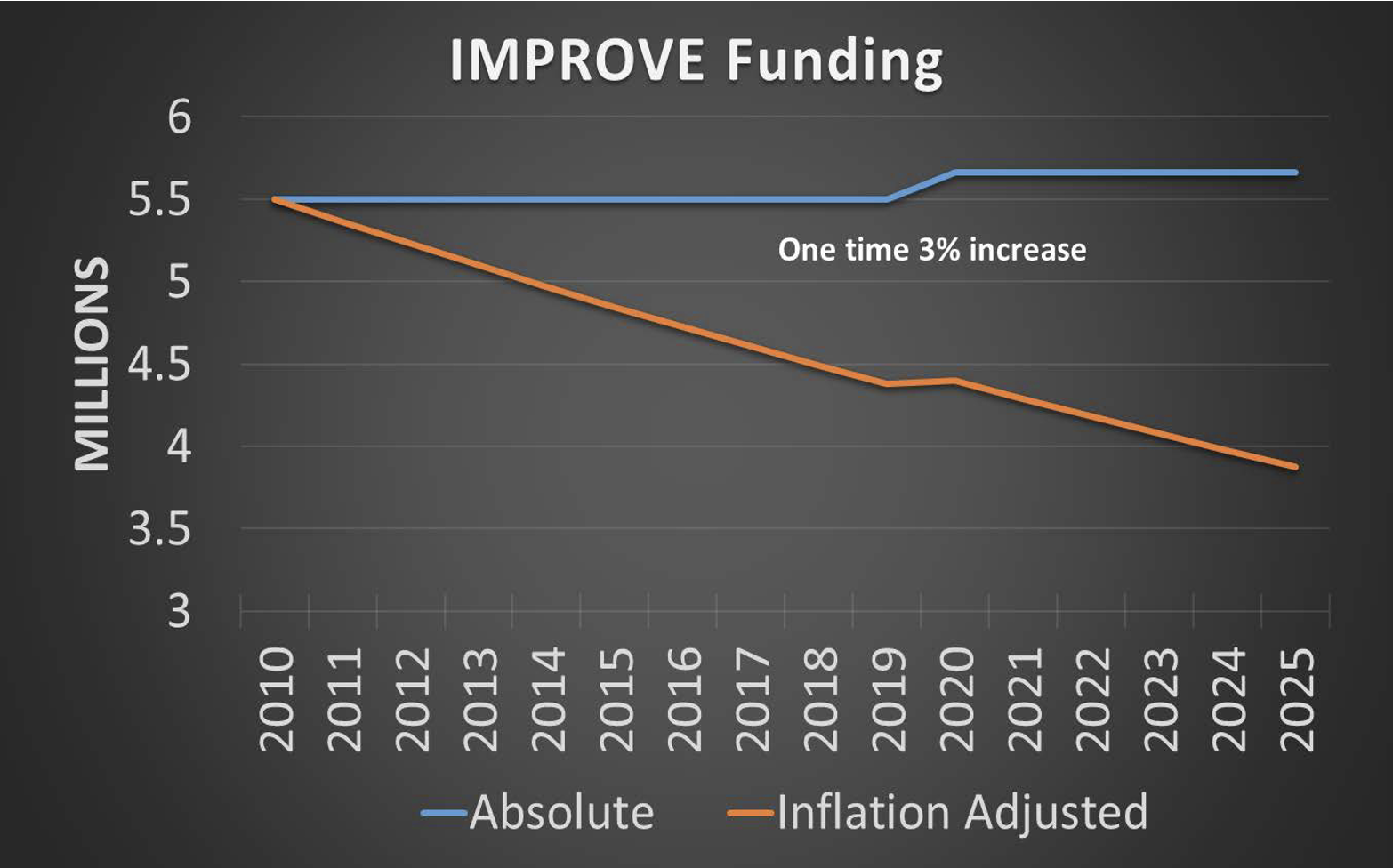
This conceptual graph, shown in a recent presentation to state agencies, illustrates how IMPROVE’s flat funding has lost value over time, thanks to increased inflation. [Credit: Scott Copeland]
The air monitors throughout the over 150 protected areas work through their four-pronged tubular devices, sucking in air and trapping tiny polluting particles in filters. After collection by site operators, the particle-packed samples are shipped to labs including UC Davis’s Air Quality Research Center, where researchers analyze their chemical composition to determine where this pollution originated from and whether it was caused by human activity.
This chemical analysis can help unpick whether, say, a hazy period at the Grand Canyon was caused by wildfires or smog swept by the wind from Los Angeles. “It all shows up in this data set,” said Scott Copeland, the lead data analyst of the IMPROVE program and former chair of the steering committee.
IMPROVE’s main goal, Copeland said, is to track how states have progressed under the EPA’s Regional Haze Rule. The data is used to compare how air visibility levels have improved in comparison with an imaginary line that starts with 2000’s relatively poor air quality levels and ends with no manmade pollution in 2064.
In addition to IMPROVE’s role in tracking states’ pollution, this data is also made public for use by research scientists and environmental organizations. “It is a really good snapshot of what is in the atmosphere at any given time,” said Copeland, making it a useful resource for scientists studying all kinds of atmospheric events from dust storms to wildfires.
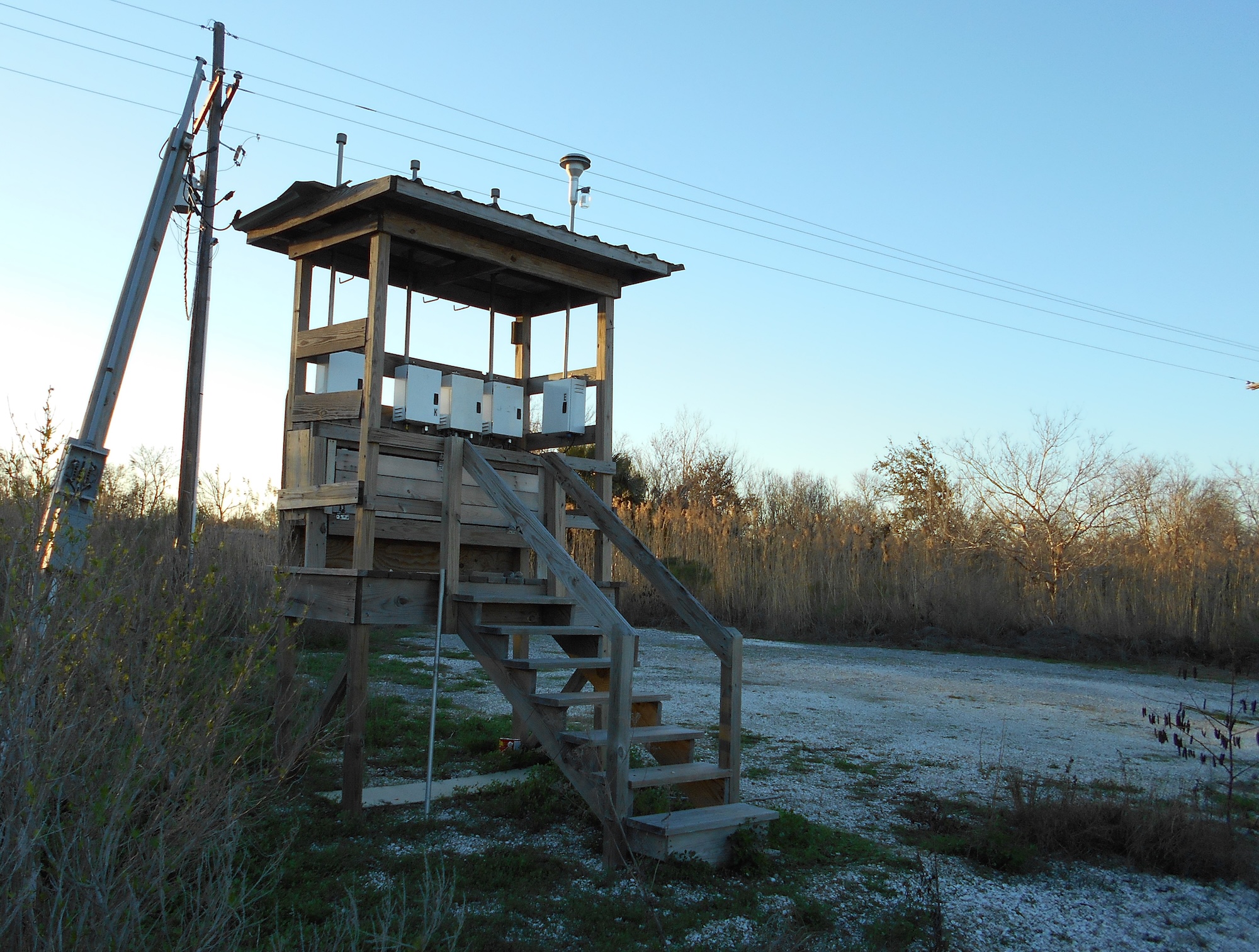
This monitor in Breton Island, Louisiana, is composed of four distinct samplers, which each track different types of particles. The samplers sucks in air from their surroundings, trapping small haze-producing particles in a filter. [Credit: Scott Copeland]
Funding pressures have long affected IMPROVE, said Copeland. “It’s always been that way, and I think it always will be.” A limited budget is not inherently bad, he said. His concern is where staffing, infrastructure or scientific quality are jeopardized.
In recent years, though, the gap is widening between this flat line of funding and rising costs. As a result, IMPROVE is ramping up cost-cutting measures. In January of 2027, nearly a quarter of the 110 sites will switch to data collection every six days, versus every three days. And three sites have had to stop collecting data altogether due to damaged infrastructure or lack of site operators. These changes were decided in October of 2024, before the Trump administration took office, according to Copeland.
IMPROVE’s monitoring rollback is “very disappointing,” said Ulla-Britt Reeves, the director of the National Parks Conservation Association’s Clean Air Program. “I think it’s going to lead to less information, less quality information. It’s going to harm our understanding of trends over time.”
Reeves says that we shouldn’t blindly assume that air pollution will continue to decline. She is particularly concerned about the Trump administration’s moves to reopen coal-fired power plants and roll back clean vehicle rules. “The job is not done,” she said. “Air quality is not a static situation.”
While these changes will “somewhat degrade” air visibility tracking, Copeland said, the hope is that statistical methods will limit the damage to overall data quality.
Cuts have been concentrated on the least important air monitoring sites, where air quality is cleanest, added Chet Wayland, the former director of the EPA’s air quality assessment division, who retired in 2024.
Still, Wayland noted the inherent loss that comes with closing sites. “My concern has always been: Well, if you stop monitoring somewhere, how do you know if air quality is still good?” he said. “You don’t, because monitoring is how we know that.”
IMPROVE’s current financial woes stem from a wider problem in air monitoring funding, said Wayland.
Each year, the EPA receives an air monitoring grant from Congress, which it splices and distributes to air quality projects, including IMPROVE. But Wayland says this larger pool of funding hardly grew in his twenty years at the EPA.
He suspects that funding stagnated, ironically, due to the projects’ success at reducing air pollution. “People assume that maybe you don’t need as much monitoring because air quality has gotten better,” he said.
The IMPROVE committee continues to strategize to cut costs, beyond the actions they’ve already taken. An NPS spokesperson said that they are considering cutting costs on equipment, axing “less essential” forms of sample analysis — like weighing the total mass of PM2.5 and PM10 (slightly larger polluting particles) on filters –– and reducing data collection frequency at an even greater number of sites.
It’s an inherent trade-off between money saved and data lost, though. Both of the latter two options would introduce more uncertainty into data measurements, according to simulations the committee ran.
Ultimately, IMPROVE needs an influx of money, UC Davis’s Wexler said. “There needs to be some more funding, which means we have to get the attention of Congress,” he said.
Obtaining funding for infrastructure can be difficult, though, Wayland said. “People want to fund the glitzy things or the things that are going to get some attention,” he said.
Air quality monitoring, on the other hand, is closer to getting an oil change on your car. “You have to do the infrastructure stuff to make sure your car’s going to continue to run well,” he said. “People don’t get excited about it. It’s just part of what you have to do.”
Filed To
Share
About the Author

Georgia Michelman
Georgia is a New York-based science and health journalist. She has an academic background in physics and astronomy, but also has strong interests in controversial health stories.
1 Comment
It’s alarming that a network covering 156 national parks and forests could be weakened by financial pressures. The dedication of operators driving, hiking, and even cross-country skiing to 110 remote sites shows how much effort is required to preserve this vital record of air quality and visibility.