Two U.S. economists win Nobel for work incorporating consumers’ views into boom-bust predictions
This year’s prize highlights Robert Hall and Michael Woodford’s work developing models that take future expectations of the public into account in economic policy
Marta Zherukha • October 12, 2026
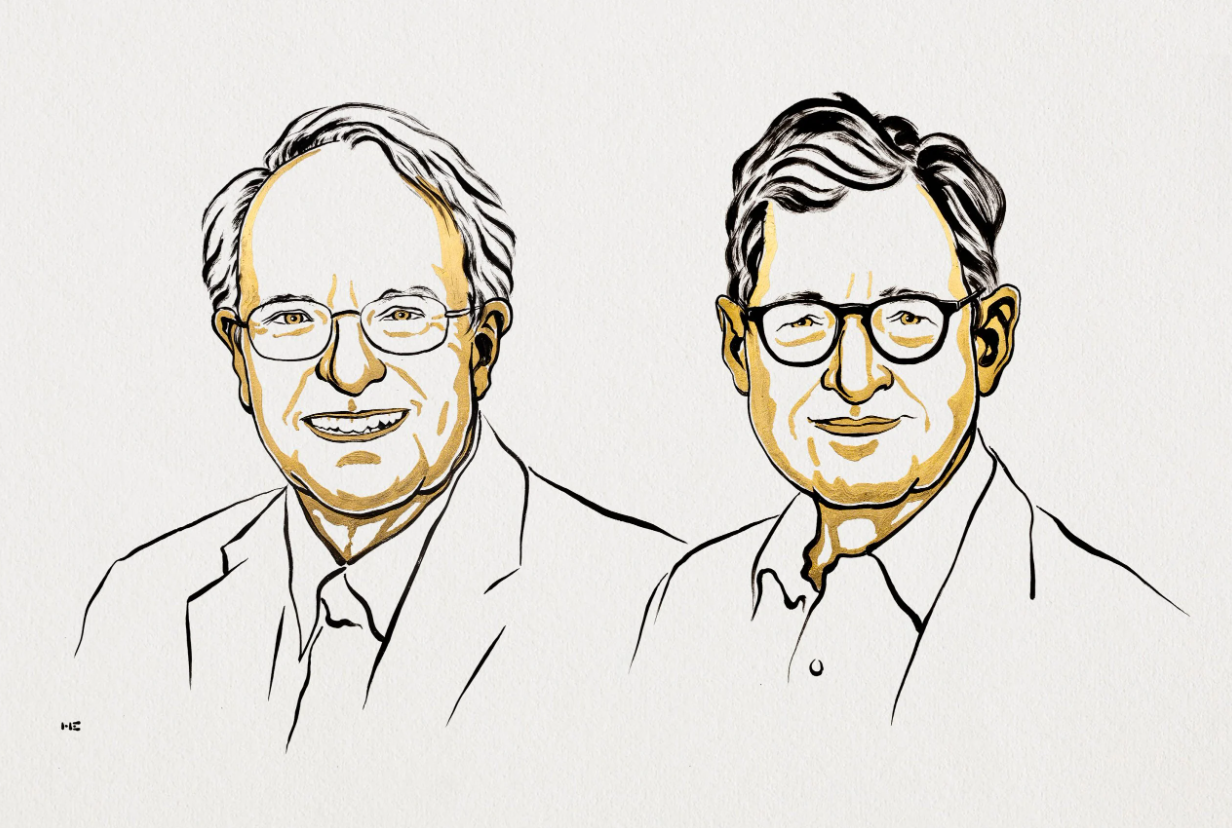
An illustration of Robert E. Hall and Michael Woodford, winners of the 2026 Nobel Memorial Prize in Economic Sciences. [Credit: Niklas Elmehed © Nobel Prize Outreach]
Two U.S. economists won the 2026 Nobel Prize today in economics for creating new models that help stabilize countries in tough financial times.
Robert Hall and Michael Woodford updated a classic economic theory after the 1970s oil crisis, restructuring the question of supply and demand to also include consumer expectations. The old theory by John Maynard Keynes was “a black, unreliable box,” said Timo Boppart, a member of the prize committee.
While the old theory looks exclusively at high-level economic decisions, how governments could intervene via taxes and spending, he said, the new one takes decisions by individual households and businesses into account. This smooths out bumps in the economy by understanding actual consumer behavior instead of relying on top-down statistics.
“Disposable income matters, but also the entire future path of income is relevant, too,” Boppart added. “If consumers see dark clouds on the horizon, they cut back on consumption.”
Hall studied consumption, and he found a way to quantify its theories. In 1978, he reasoned that if consumption is based on all past choices, changes only happen with new information. So, changes in consumer behavior are unpredictable.
Boppart used an illustrated ice cream menu to explain Woodford’s part of the theory: how people spend money and how businesses set prices. In this analogy, the microeconomic foundation is how much people are willing to pay for a summer treat. That foundation sits under the overarching goal of macroeconomic stabilization — how much the truck can reasonably charge for one.
Under the old Keynesian framework, the ice cream truck driver keeps the price the same each year without considering a change in supply or demand. Under the new framework, the driver adjusts prices early in the summer based on predictions like weather forecasts and tourist numbers.
“Price-setting becomes forward looking,” Boppart said. “If you know that the price of your ice cream is gonna last for the whole season, you better look ahead when you set it in the first place.”
Woodford said his work stresses the importance of government transparency when making economic policy. According to him, people understanding the future of their financial decisions is crucial to those policies actually working.
“Government authorities shouldn’t view stabilization of the economy as an exercise that is simply conducted by people pulling levers to control the economy independently of what people in the economy understand about this,” Woodford said in a phone call with the prize committee.
Hall teaches applied economics at Stanford University, and Woodford teaches political economy at Columbia University.
Hall and Woodford won 12 million Swedish kronor (almost $1.2 million), which will be split equally between them. The economics award wasn’t in Alfred Nobel’s will, so it isn’t technically a Nobel prize. It was added to the original set by Sweden’s central bank to celebrate its 300th anniversary in 1968.
In a press conference Monday morning, Woodford referenced the 2008 financial crisis as a key period when traditional tools like Keynes’s weren’t enough to restore economic activity.
The conventional path was to cut interest rates to stimulate spending, which happened in the U.S. and other countries around the world. However, rates remained at basically zero by the end of the year while spending remained low and unemployment high. Governments had to try something different.
The new theory helped deal with the problem by asking governments and banks to be more transparent about the likely future path of that policy. Woodford said forward looking contributed to better stabilization.
Hall’s and Woodford’s framework is also helpful in challenging times brought on by non-economic events, like the Iran-U.S. War that has disrupted the energy market.
“It makes me very excited to see this core macroeconomic topic being rewarded with a prize,” Boppart said.
Filed To
Share
About the Author

Marta Zherukha
Marta Zherukha studied journalism and international studies at the University of Florida before joining SHERP. The first article she published was on Florida’s springs, and she’s been obsessed with sharing science stories ever since. Marta is most interested in the environment and public health, but she finds new science topics to dive into every day.