Digging up the past at Dead Horse Bay
The Brooklyn beach was closed in 2020 after radiological contamination was found. What's happened since?
Sarah Hofmann • March 12, 2026
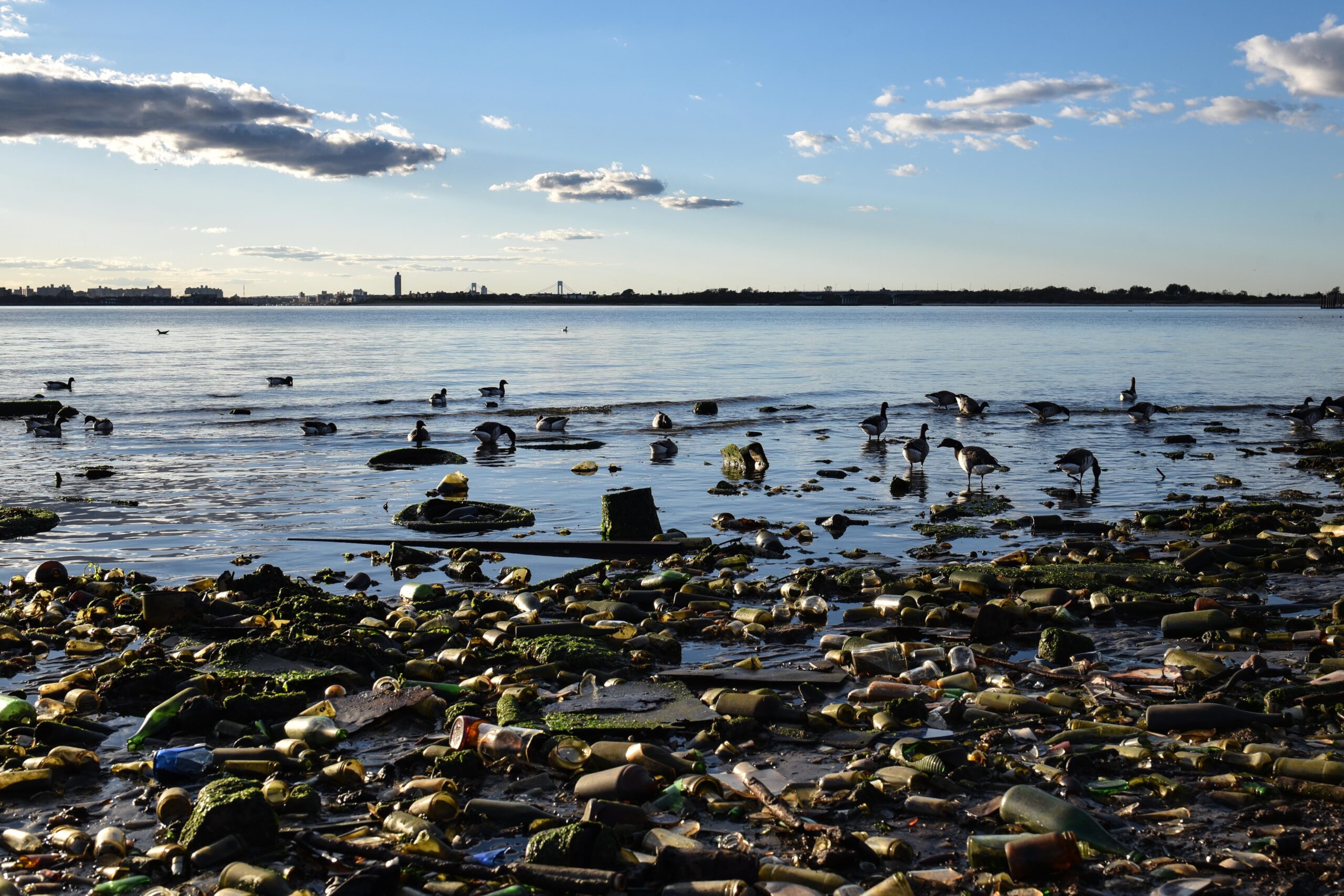
The shores of Dead Horse Bay in Brooklyn could be hiding radiological and chemical contamination. [Credit: Sarah Hofmann]
In 2020, the National Park Service announced the closure of Dead Horse Bay, a section of water and shoreline within the Gateway National Recreation Area in Brooklyn.
Survey results had shown radiological and chemical contamination at the popular beachcombing spot, and the park service said that a federal cleanup effort would follow.
More than five years later, the closure is still active, the paths are overgrown and the beach appears to be untouched. Here’s a look at what’s happening — or not — down at Dead Horse Bay.
(Scienceline intro music)
Sarah Hofmann: Hello! And welcome back to Scienceline. I’m Sarah Hofmann, the digital editor, and for this episode, you’re stuck with me!
I’m here to tell you about the past and present of a place called Dead Horse Bay, and what’s being done to address contamination found at the site found several years ago.
If you enjoy this piece, please keep up with Scienceline and its intrepid staff of grad student journalists by signing up for our email newsletter, subscribing wherever you get your podcasts, or by following us on Instagram, Bluesky or X (the website formerly known as twitter).
Here’s the story, which was recorded in late 2025.
(Taped in October-November 2025)
(field tape of water and birds at beach)
Sarah Hofmann: Along the south edge of Brooklyn, about a mile east of Manhattan Beach, is a small body of water called Dead Horse Bay. The bay and surrounding coastline are part of the Gateway National Recreation Area. In recent years, the shores of Dead Horse Bay have been popular with beachcombers and mudlarkers looking for treasures and historical artifacts.
Then, the National Park Service, which oversees the area, announced in 2020 that Dead Horse Bay would be closed to the public due to radiological contamination.
But, a few weeks ago, I decided to pay the beach a visit.
Before the closure, people could access the bay via foot trails that cut through a wooded area — but after five years, the underbrush has taken over. At the trail head, a chain, an orange traffic barrier, and a few warning signs have been put up to discourage visitors. One sign warns of “potential hazardous material.” Another says the area is closed due to “emergency conditions.”
(field tape)
Hofmann: Walking up to the beach from the south, there isn’t a whole lot to look at. There’s plenty of broken glass and pieces of brick on the shore, and there are pieces of bone, although I’m not sure how to tell if they came from a horse or not. There’s algae on the rocks… and there’s a smell of oil or some kind of chemical in the air. If any cleanup work or removal of land has been done since 2020, it isn’t obvious.
I wanted to find out what happened here.
(music)
Hofmann: I’m Sarah Hofmann, this is Scienceline, and here’s what’s going on at Dead Horse Bay.
To understand what’s happening now, it helps to have some historical context.
Part of the land surrounding Dead Horse Bay used to be called Barren Island. Starting in the 1850s, the island was home to a number of waste-processing facilities, including glue factories that dealt with the city’s dead horses. At times, they collected hundreds a day.
And, in case you weren’t sure: that is how the bay got its name.
Miriam Sicherman: The garbage would come in, it’s all basically — pretty much — all organic garbage, and it would be compressed and boiled, kind of, into this sort of — I don’t know, soup — that you could then skim off the oil from. And then the rest would be incinerated, or just dumped.
Hofmann: That was Miriam Sicherman, an elementary school teacher and local historian. She wrote a book about Barren Island’s history.
By the 1920s, Barren Island’s waste industry and community had dwindled. Soon after, an airfield was built in their place, and the island was connected to mainland Brooklyn. In the decades that followed, parts of the new peninsula along Dead Horse Bay were built up with landfills.
(music)
But the past didn’t stay buried for long. The ground covering the landfill started to erode along a section of shoreline — now called Glass Bottle Beach — and all kinds of 1950s-era garbage started to resurface. As the park service put it: “There is a history buried in South Brooklyn. As a matter of fact, that history pours into the bay.”
Remember how I said the area was popular with beachcombers? That’s why. The landfill is a goldmine for treasure hunters and history buffs — but some of those treasures may contain radiation and toxic chemicals.
That brings us back to the 21st century.
In 2019, a park service field survey found radiation along the trails and beach. They said the survey was done because two nearby areas with similar histories had already been designated as CERCLA sites — and, on top of that, the Army Corp of Engineers had found chemical contamination at Dead Horse Bay in 2002.
CERCLA, also known as Superfund, lets the federal government take action when hazardous substances are found that might endanger the public’s health or the environment.
It’s not clear why they waited years to do the survey — but they did find elevated radiation in 31 locations across Dead Horse Bay. That included two radioluminescent deck markers that likely came from the landfill. The deck markers are little discs — maybe two inches across — that contain glowing radium. The military used them to identify edges of ship decks in the dark.
The park service later said that the levels of radiation present were not considered to be a significant health risk — but, quote, “the full nature and extent of” the chemicals and metals present are still unknown.
As it turns out, more walk-over surveys were done in 2021 and 2023, according to a brief community update from May. Both times, more areas with elevated radiation were found. Some of this was due to black monazite sand, which contains naturally-occurring radioactive minerals and isn’t dangerous. Still, the surveys led them to close another 40 acres of the park, which made me even more curious about what else they’d found.
The best place to get answers would have been the National Park Service — but, just as I embarked on this story…
(montage of clips from news broadcasts)
Hofmann: …as a result of the shutdown, many federal employees were furloughed. That seemed to include the staff who might have been able to answer my questions.
A park service document said the chemicals found on the beach include pesticides, metals, polycyclic aromatic hydrocarbons and polychlorinated biphenyls. Polycyclic aromatic hydrocarbons occur naturally in things like coal and gasoline. They’re also produced when stuff is burned. Polychlorinated biphenyls are a group of man-made chemicals that were banned from production in 1979.
The health risk from any of these would depend on the specific chemicals, their concentrations, and how much exposure someone has to them. And those are answers we don’t have yet.
So, what about the radiation? I didn’t have the survey results, but I still wanted to get some idea of how worried we should be about Dead Horse Bay.
Here’s what Robert Hayes, a health physicist and Associate Professor of Nuclear Engineering at NC State had to say about radiation exposure:
Robert Hayes: You assume, most people assume, that a regulation is safety-based. In most industries it is. In nuclear, it’s not. So when it comes to nuclear, the regulations are usually orders of magnitude below anything that would cause a measurable health effect.
Hofmann: In other words, the minimum radiation levels that would cause an area to be closed or even evacuated are lower than the levels that would make someone sick, at least in the short term. I asked him about the deck markers, which contain between 5 and 15 microcuries of Radium-226, according to Oak Ridge Associated Universities.
Hayes: The biggest damage might be from actually eating the item. That would probably be the biggest issue. Just don’t eat it.
Hofmann: So, if someone took something like that — took it home, put it on a shelf — they’re unlikely to develop serious —
Hayes: Oh, goodness, no. So if you had that in your house, if you broke it, you would get contamination limits that would not be acceptable in a nuclear facility. Now, it’s not gonna cause any health issues, but it would be above that which is legally allowed for people to be exposed to. Again, those numbers are really, really small.
Hofmann: Robert said that the types of contaminants that had been identified — radium, thorium, and uranium — are all naturally-occurring, though they can definitely be dangerous above a certain concentration. He also said that this kind of radiological contamination shouldn’t affect the environment itself.
So, while it’s possible that more dangerous radiation is lurking in the bay, the initial findings are nothing to write home about.
Miriam, our historian, had a similar takeaway:
Sicherman: There’s gross stuff there, and I’m sure that, like, apart from the radiation, there may be like toxic stuff that’s leeched into the soil or whatever, but it’s not like you’re picking it up and eating it, so…
I mean, I also assume, although this might be naive, that if it were really dangerous they would do a much better job of keeping people off the beach.
Hofmann: She was right about the beach — despite the overgrown trails, it wasn’t exactly hard to get to.
(music)
A recent study found that about 80% of the US population lives within 6.2 miles of a Superfund site. That’s not to say that we’re all in danger, but it does illustrate how many places like Dead Horse Bay are scattered across the country. Maybe it’s not surprising that things aren’t moving faster.
But what happens next?
Based on park service documents, it’s hard to tell if field investigations that were slated for this year have actually happened yet, or how long they’ll take.
(field tape of water)
But the results should help the agency evaluate cleanup options. Next, they’ll create a “Proposed Plan.” There’ll be a public review period, then finalization of the plan, and, after a few more administrative steps, Dead Horse Bay’s cleanup might finally start.
(Scienceline outro music)
MUSIC: Sudden Courier [Eltham House | Blue Dot Sessions] | Under The Wire [Transistor Radio | Blue Dot Sessions] | Scienceline theme by Jahzzar at the Free Music Archive AUDIO CLIPS: Newsweek, ABC News, Bloomberg Television, and WHNT News 19
Filed To
Share
About the Author

Sarah Hofmann
Sarah is a New York City-based journalist and writer. She’s especially interested in stories about public health topics, and the science, people and policies that shape them.