Nobel Peace Prize awarded to Navi Pillay for enforcing human rights protections in international law
Navi Pillay’s win sends a “message to those attacking and undermining international law”
Bela Silverman • October 9, 2026
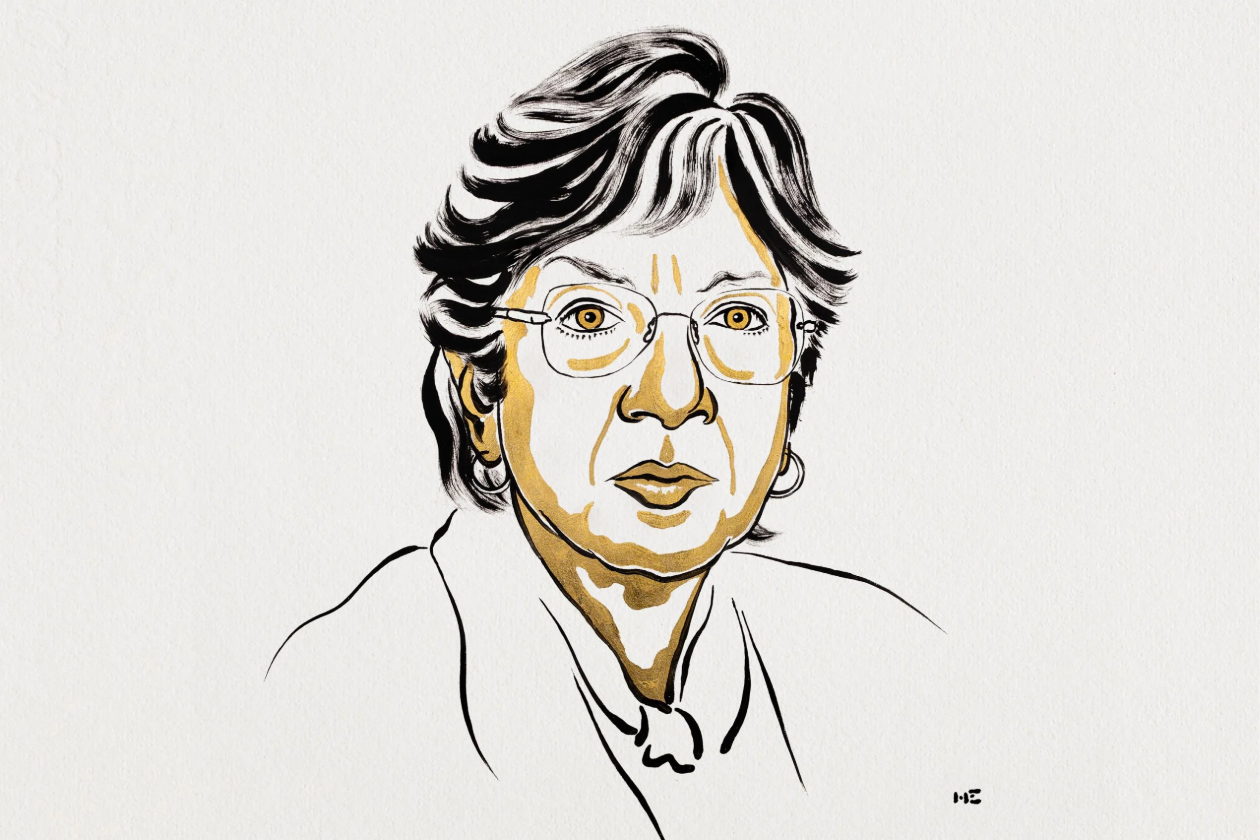
An artist’s illustration of international jurist and human rights lawyer Navi Pillay, who has won the 2026 Nobel Peace Prize [Credit: Niklas Elmehed | © Nobel Prize Outreach]
The 2026 Nobel Peace Prize has been awarded to human rights lawyer Navanethem ‘Navi’ Pillay for her lifelong efforts to combat war crimes and promote peace.
Currently serving as an ad hoc judge on the International Court of Justice in Myanmar’s Rohingya genocide case, Pillay’s role underscores her commitment to upholding international law in conflict zones.
“At a time of existential challenges, including more wars and conflicts than the world has seen in a long time, international law is no longer just a supplement to peace and security,” said Jørgen Watne Frydnes, chair of the Norwegian Nobel Committee, in Friday morning’s announcement. “The judges, those who guard the thin red line between order and chaos, are therefore highly deserving of our praise.”
Born in Durban, South Africa, the 85-year-old laureate has made her mark on international law over an extensive career, beginning with her defense of Nelson Mandela and members of the anti-apartheid movement in the African National Congress. In 1995, Pillay was appointed to the High Court of South Africa, and soon after became a judge and the President of the International Criminal Tribunal for Rwanda (ICTR), where she “established that rape and sexual violence could constitute a crime against humanity as well as genocide,” noted the Nobel committee.
Following her time at ICTR, Pillay served on the International Criminal Court (ICC) and, from 2008 to 2014, as the UN High Commissioner for Human Rights. There, she pushed for investigations into alleged war crimes and human rights abuses, notably in Syria and Sri Lanka, oversaw the 2009 UN world conference against racism, and voiced support for the 2011 UN resolution advancing LGBTQ rights.
Pillay recently chaired the UN investigation on alleged human rights violations in occupied Palestinian territories, where the commission concluded that Israel had committed genocide against Palestinians in Gaza. The investigation sparked backlash from both the U.S. and Israel. Following the Trump Administration’s sanctions on several ICC judges last year, Marco Rubio, the U.S. Secretary of State, said today that the U.S. would move to enforce financial sanctions on the ICC. In the same vein, Israel’s UN ambassador, Daniel Meron, “categorically rejects the libelous rant.”
This marks the third consecutive year a woman has won the Nobel Peace Prize. The 2025 winner, Venezuelan opposition leader Maria Corina Machado, gave her Nobel Peace Prize medal to President Donald Trump weeks after US forces seized Venezuelan President Nicolás Maduro.
While the rest of the world learned of Pillay’s win from the committee’s announcement, she found out from a surprising standing ovation while attending a forum at the Nuremberg Court in Germany. Caught in complete disbelief, she waved away the applause, quipping, “If you clap a little bit more, I may share this prize with Trump,” and joked, adding, “Being a lawyer and a judge, I still want to verify this information.”
In its announcement, the Nobel committee highlighted the importance of upholding the integrity and power of international law, saying that it will “never be perfect, and never has been able to prevent all conflicts, but it sets the standards. Legal measures do prevent acts of war and violence. That is a fact. We want to remind the world that the cornerstone of a more peaceful world is strengthening,” said Frydnes.
Despite her lifelong service, and a new medal to go with it, Pillay has no intention of slowing down. Addressing her colleagues in Germany this morning, she said, “Everyone keeps asking me: when will you stop? I’ve only just turned 85 last month.”
Filed To
Share
About the Author

Bela Silverman
Bela Silverman is a science journalist based in New York City with a background in climate science. She covers issues within the realm of science, health, and the environment, with a focus on climate justice and conservation.