Joshua trees face an uncertain future
As wildfires, habitat loss and other threats close in, scientists are researching ways to preserve the iconic species
Sarah Hofmann • November 25, 2026
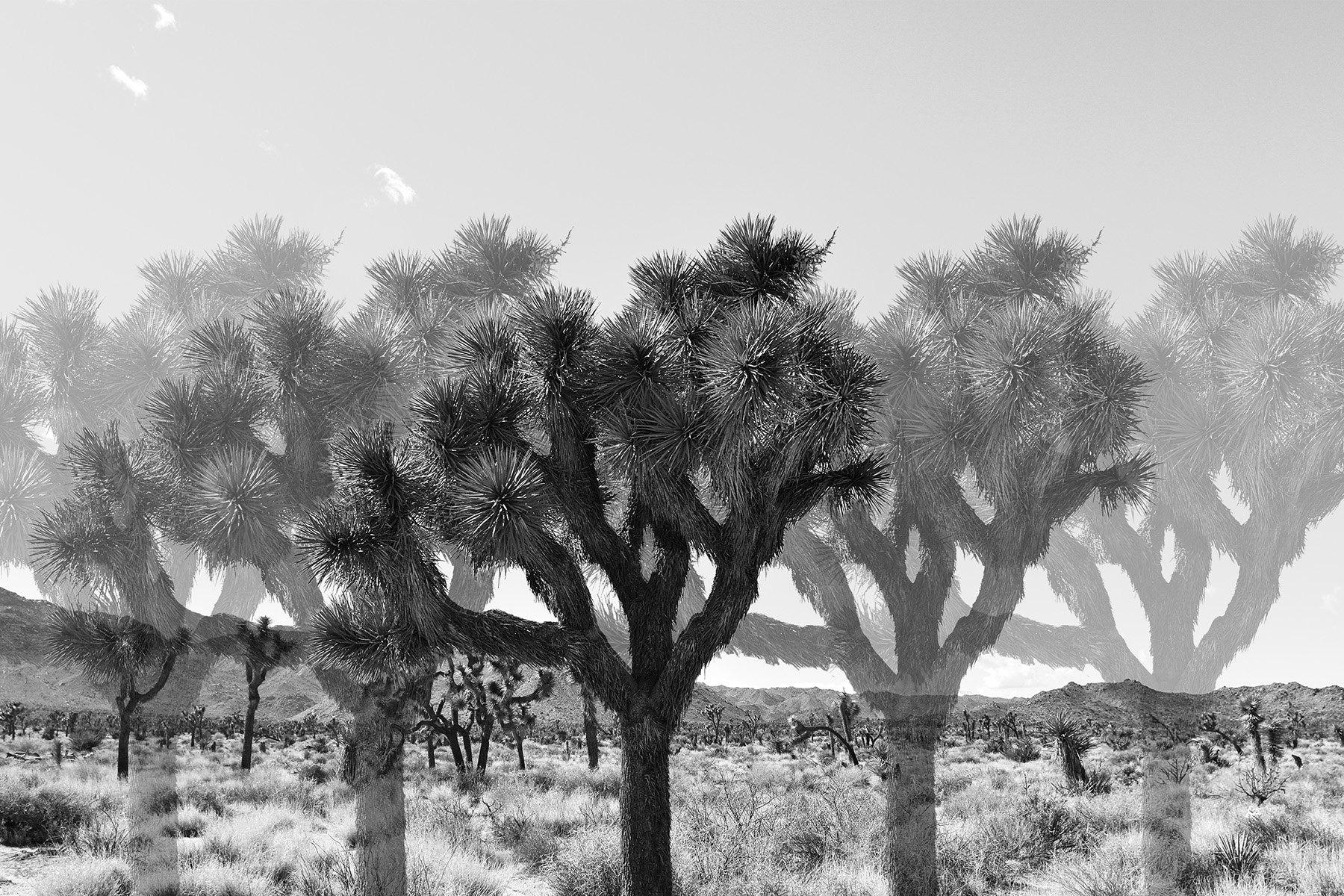
Joshua trees are projected to lose much of their habitat by the end of the century. [Credit: Sarah Hofmann]
In the millions of years that Joshua trees have inhabited the American Southwest, the landscape has changed around them. The trees weathered the warming and drying at the end of the Pleistocene Epoch, as well as the extinction of the giant ground sloths that once dispersed their seeds.
Today, the tree’s range lies mostly within the Mojave Desert where, as is the case for many ecosystems, the changes occurring today are largely driven by human activity. And though the Joshua tree has survived change before, it’s unclear how well it will fare in the coming decades.
“They’re not in a state where you would traditionally call them an endangered species,” said Jeremy Yoder, an associate biology professor at California State University Northridge, “but there is a lot of evidence that they’re going to be in trouble.”
The future could be bleak. But in the meantime, a number of researchers are betting that modern technology can give the relict species a better shot at survival.
There are several sources of concern.
Though many trees are located within two National Park Service sites — Joshua Tree National Park and Mojave National Preserve — the boundaries aren’t impenetrable. Park staff, which in Joshua Tree’s case includes about 105 full-time employees, are struggling to keep up with park operations and the needs and impacts of the roughly 3 million people who visit each year.
The Mojave Desert is also seeing a resurgence in mining, an industry that has challenged protections in Joshua Tree for nearly a century, and projects have recently been proposed both on the park’s border and within the preserve. The latter is now subject of a lawsuit, and mining operations have been halted for the time being.
This summer, the Bureau of Land Management approved a right-of-way permit for the long-disputed Cadiz pipeline, which will extract groundwater from the Mojave Desert to sell in California and Arizona. Environmental groups are also suing the Trump administration over the pipeline, alleging that the approval itself was unlawful and did not adequately account for environmental concerns.
“The BLM completed an environmental assessment and determined the right-of-way would not result in significant impacts,” Kate Miyamoto, a spokesperson for BLM, said via email, adding that the agency does not comment on pending litigation.
The NPS did not respond to a request for comment. A spokesperson for the Interior Department, which houses both agencies, said in an email that the department does not comment “on budget, staffing, or pending litigation.”
But while individual projects may pose risks for Joshua trees in the immediate area, as an NPS administrative history states, “the most insidious and uncontrollable threat to Joshua Tree affects the entire world.”
In the last century, climate change has warmed the Mojave Desert by about 2 degrees Celsius. Environmental effects have already emerged: precipitation has decreased, wildfires have increased, desert tortoise and bird populations have declined, reptiles and desert bighorn sheep face habitat loss, and in lower, warmer elevations, fewer Joshua trees are sprouting.
The most dire models predict a 90% reduction in Joshua trees’ current distribution by 2100; others estimate an 80% reduction. The trees “will slowly die off” as their surroundings become uninhabitable, according to the NPS website; and the small percentage of trees in higher, cooler elevations with more rainfall are considered to be “the likely ‘last stand.’ ”
Joshua trees have become something of a flagship species, Yoder said, because identifying the climate conditions they need and comparing them to future projections “probably gives you a sense of how that’s going to go for a lot of other species as well.” From the start, though, “it was pretty clear that future climates are going to be outside of the range of what Joshua trees currently live in.”
One of the efforts to prepare for that eventuality is the Joshua Tree Genome Project, a collaboration between researchers, conservation groups and community members that launched a decade ago with a plan to sequence the roughly 3 billion DNA bases that make up the species’ genome. The project later received National Science Foundation funding.
Yoder and his lab are among its collaborators. The end goal, he said, “is to be able to relate genetic variants to climate-adaptive traits, and then map climate-adaptive genetic variants to natural populations.” For example, if they identify genetic variants in seedlings that make them more drought-tolerant, they can then try to locate those variants in existing Joshua tree populations, and potentially replant their seeds after wildfires.
Deciding where to plant those seeds is another matter.
Fires in the Mojave desert can now spread in new ways, Yoder said, because non-native grasses have formed “a year-round, continuous vegetation cover” where there used to be bare earth. Additionally, “we have good reason to think that the worst fire risks are in places that are also what we call ‘climate refugia,’ that are likely to stay suitable for Joshua trees over the long term.”
The region has seen some severe wildfires in recent years, including the Dome Fire in 2020, which burned more than a million Joshua trees by NPS’s estimate, scorching a climate refugia, and the York Fire in 2023, which the NPS told Fox5 Vegas may have burned a million more.
“What has been seen historically are these high-frequency, low-intensity fires that tend to be more typical of these arid environments,” and which “don’t tend to get particularly hot” because of the limited amount of biomass, said Nick Gondek, a data scientist and software engineer at UC Berkeley’s Eric and Wendy Schmidt Center for Data Science & Environment. But the last few years have brought more high-intensity fires, he said, which “are burning large slots of the Mojave Desert at a really high severity.”
“These fires are getting so hot that they’re not just kind of creeping through the understory and burning up all the vegetation, the shrubs, and all the grasses and things like that,” Gondek said. “They are getting so hot that they’re burning the Joshua trees themselves.”
Increasingly, he said, it isn’t clear what to do after a fire has occurred; the amount of labor that can be dedicated to removing invasive species or replanting is limited, as are the number of seedlings available in the national park’s nursery.
Weighing each of the potential factors — the fire’s severity, the available stock of seeds or seedlings, the labor, the cost, the likelihood that the landscape will recover on its own, and the odds that another fire will occur — has become a “scenario-planning challenge,” Gondek said.
With those uncertainties in mind, the group at Berkeley has been developing digital fire recovery tools to help park rangers make decisions in the wake of a fire. The efforts have received funding from the park service in relation to its Resist-Accept-Direct framework, which shifts away from traditional views of environmental stewardship, and instead recognizes the potential that interventions have to foster preferred conditions.
The Disturbance Recovery Tool, for example, uses satellite imagery to assess a fire’s burn area and severity, which helps land managers decide how to respond in the aftermath.
Existing imaging tools weren’t ideal, Gondek said, because they typically rely on infrared discrepancies calibrated to distinguish healthy vegetation from bare soil.
“So, you can maybe make the reasonable assumption that in a forest environment, if you’re seeing bare soil, it’s because there’s been some sort of disturbance,” he said, but that isn’t necessarily true in places like the Mojave Desert. So, they made adjustments to reflect the landscape’s pre-fire conditions.
The tool was used twice last year following the Eureka and Black Rock fires, which together burned about 272 acres in the national park. The process involved a lot of “back and forth co-design work” and analysis with NPS, which included using the burn tool in conjunction with existing vegetation maps to get a sense of the fires’ severity, but also their destruction, Gondek said. For example, “a low-severity fire might be very destructive, depending on what the actual vegetation community is there.”
The researchers are now working to scale the tools for other ecosystems, and have built out other applications, including a model that uses burn severity and vegetation to create projections of different vegetation recovery trajectories, which they named Josh.
“One of the benefits of having built this tool in a very general manner is that, when we’re working with these other environments like the chaparral down in the Mediterranean Network, or sage brush up in the Great Basin, it’s not a huge lift for us to try a different model for a totally different environment,” Gondek said.
Efforts to protect Joshua trees and the federal lands they inhabit continue to face obstacles. The Interior Department recently blocked funding for 140 NPS agreements slated for this fiscal year, including 10 in Joshua Tree, according to the Center for Western Priorities and The Washington Post. The agreements — which would also fund additional staff — addressed wildfire preparedness, burn area rehabilitation, deferred maintenance and other work needed to ensure that upcoming projects meet federal regulatory requirements.
Looking ahead, Joshua tree conservation will include a combination of approaches, including more aggressive fire prevention, and matching genetic potential to climate conditions to improve replanting efforts’ yield, Yoder said.
Other work involves “figuring out basic procedures,” as with experiments being done at Mojave National Preserve that hope to determine whether putting seedlings under shade or beside a native shrub — a “nurse plant” — improves their chances. Meanwhile, another Joshua Tree Genome Project collaborator, Willamette University biologist Chris Smith, is exploring how arbuscular mycorrhizal fungi, which help plants respond to drought conditions, could play an important role in how Joshua tree seedlings can withstand climate change.
Joshua trees’ future, Yoder said, involves “acknowledging that we have a lot of eggs still in the basket… and we want to really watch the basket.”
Filed To
Share
About the Author

Sarah Hofmann
Sarah is a New York City-based journalist and writer. She’s especially interested in stories about public health topics, and the science, people and policies that shape them.