How some New York City bats are surviving a deadly epidemic
White-nose syndrome is more likely to kill bats that hibernate in caves than those that live in urban areas, experts say
Magali Gauthier • October 30, 2026
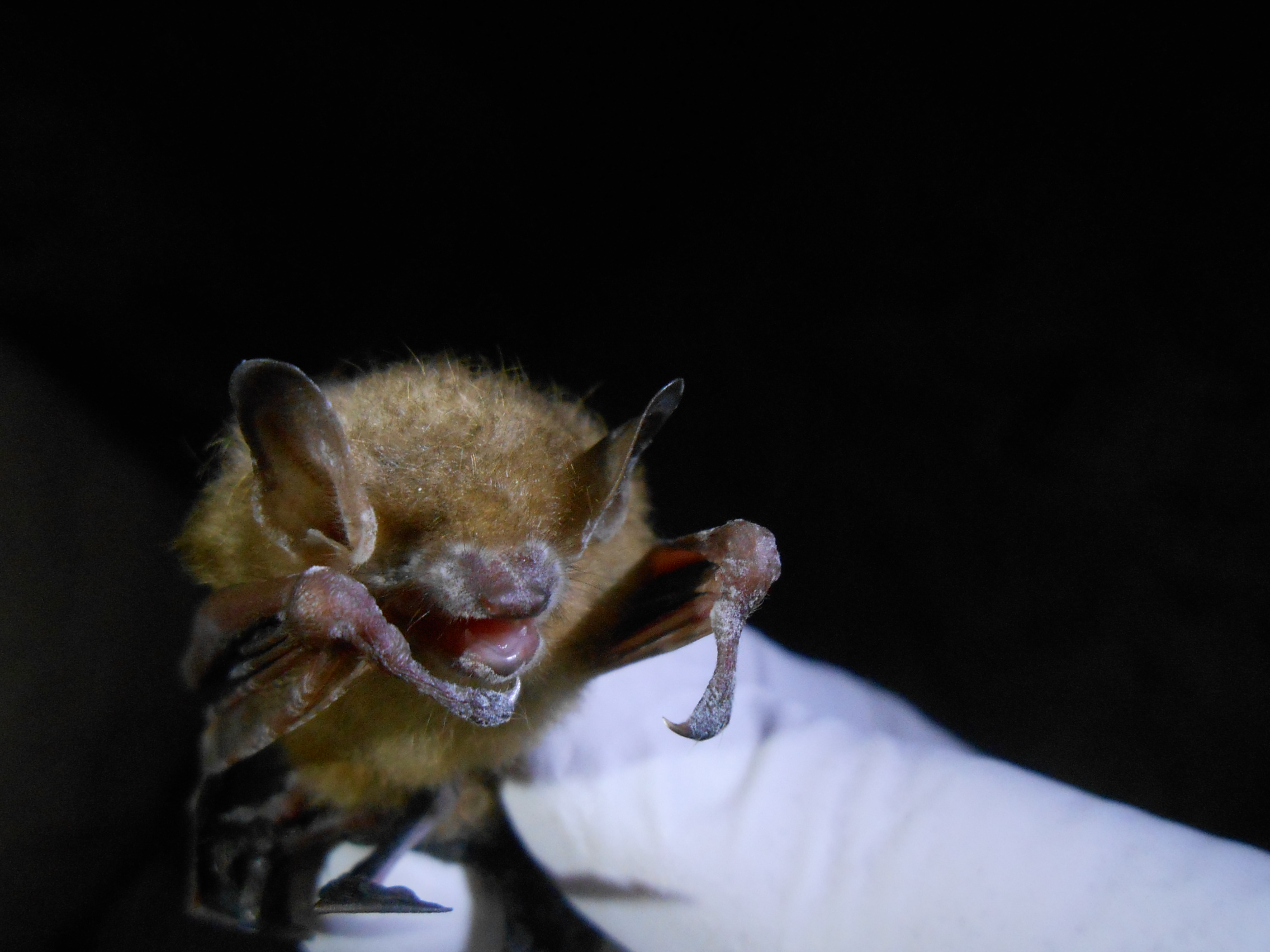
A tri-colored bat shows signs of white-nose syndrome on its face and wings in Georgia in 2013. [Credit: National Park Service | Wikimedia Commons text | CC By 2.0 text]

White-nose syndrome has killed millions of bats in the two decades since it was detected in caves in upstate New York. Some species’ numbers have plummeted by more than 90%.
As the epidemic has spread across the United States, biologists have been hard at work developing ways to help bats fight the infection. They’ve also been trying to figure out why some bat species are so severely impacted by the disease.
Over the last month, Magali Gauthier spoke to experts about what they’ve learned and how New York City bats have fared in the face of the epidemic.
(Scienceline intro music) Sarah Hofmann: Hello! Welcome back to Scienceline. I’m Sarah Hofmann, the digital editor, and today, Magali Gauthier is here with a story about how bats in New York are faring in the face of white-nose syndrome. The deadly disease has left biologists scrambling to find ways to help fight the infection; but two decades in, there’s some good news. Here’s Magali. (music) (field tape) Magali Gauthier: So cute! Nic Comparato: I call them the Donatella Versace of the skies. Gauthier: Why do you call them that? (end field tape) Gauthier: This is Nic Comparato, a New York City bat scientist. And I’m Magali Gauthier with Scienceline. We’re in Prospect Park, and Nic is telling me about these really cute, really furry bats called hoary bats. Turns out, the females are kinda independent queens. And after they’re done mating, they just bounce. (field tape) Comparato: And, like, it’s just something about that sort of, like, high energy diva, like, with like the golden blond mane, it just, I don’t know, speaks to, like, the queen of a fashion brand to me. (end field tape) Gauthier: But we’re not just here in Prospect Park to discuss these little bat divas. We’re here because multiple bat species in New York City appear to have been spared from this really awful disease. It’s called white-nose syndrome. And it’s killed millions of bats in a little over two decades. Tina Cheng is a bat scientist at Bat Conservation International. She leads research into white-nose syndrome. She says it’s caused by a fungus that creeps up on the bats when they’re hibernating. Dr. Tina Cheng: So then the fungus will start invading the skin tissue. Gauthier: It spreads on their wings and grows on their noses. It wakes the bats up when they should be sleeping and conserving their energy. Cheng: The problem with that is that bats come in with a certain amount of fat, a certain amount of energy that they need to save to make it through sometimes like five, six months of winter. Gauthier: Eventually, the constant waking up… Cheng: … causes them to burn through their fat reserves and starve to death. Gauthier: The disease was first detected in the U.S. in caves in upstate New York. Photographs taken in the mid-2000s showed bats with white fuzz on their noses. And Tina says one biologist describes stumbling on the devastation of the disease early on. He was studying bats in caves… Cheng: … and instead of finding all the bats up on the ceiling like he normally does, there were just piles of dead bats on the ground. Gauthier: Since then, the disease has spread across the U.S. Within some species — it’s killed more than 90% of bats. But there’s something interesting with the way the disease spreads. It doesn’t hit all bat species equally. The disease is mostly found in cold, damp places like caves or mines. And it spreads most easily when bats are packed together, like when they’re hibernating in large groups. So for bats that hibernate in warmer, drier places in smaller groups — they’re not getting as sick. During a recent study, researchers found bats spending the winter in crawl spaces under houses. And some of the bats did get sick, but some of them survived the infection. And Tina pointed out that some bats don’t hibernate at all, so they don’t tend to catch the disease. So, knowing this, I wanted to learn a bit more about what was going on with New York City’s bats. Let’s go back to Nic Comparato in Prospect Park. (field tape) Gauthier: So to recap, what have we seen? What have we heard, rather? Comparato: Lots of eastern red, hoary bat and big brown bat. Gauthier: Ok, sweet. (end field tape) Gauthier: These three bats are some of the most common bats in New York City. According to Nic, they’ve been popping up in the data for years. Comparato: What’s saving a lot of urban bat populations are, like, and you do see it across cities, is that bats that do well in cities tend to be ones that, like, would naturally avoid caves anyways. Gauthier: So take the eastern red bat. It’s around the length of a credit card. Toasty red coloring with a little bit of gray. Comparato: Often compared to, like, powdered jelly donuts. Gauthier: We don’t know a ton about where they go in the winter, but we know they don’t hibernate in caves. There’s also the hoary bat — that’s the little diva we met at the start of the episode. And it heads south where it’s warmer for the winter. It avoids damp, dark places. And there’s the big brown bat. Nic says it’s basically a New York City resident. Comparato: This bat will just find, like, a really nice protected spot, usually in the cracks or crevices between old brickwork like on the outside of apartment buildings. And it’ll stay there, like, all year long. Also very New Yorker-y in the sense that it’s just going to shove itself into any hole that it can, like, fit its body into. No standards. Gauthier: Apparently no standards, but again, no caves. These three bats just don’t hang out in places where the disease will get them. But… Comparato: …there is one bat that, like — at least it’s been absent from my data for at least three years now — which is the tricolored bat. It used to be a relatively common bat here in the city and was like our smallest bat, arguably our cutest. Gauthier: And that little cutie is different from the other New York City bats because it does hibernate in caves. Nic estimates we’ve lost around 90% of their population here in the city. U.S. Fish & Wildlife is currently considering listing the tricolored bat as endangered. (music) Gauthier: Giving bats endangered status is one way to help them. But Tina pointed me to some other work that’s going on too. Notably, scientists have developed a bat vaccine. And U.S. Fish & Wildlife wants to get it out to a lot more bat colonies. Researchers are also testing out sprays. They are spraying probiotics on cave walls and ceilings. The probiotics then get on the bats’ fur and skin and protect them from the fungus growing on them. (music) Gauthier: And for those who want to see your friendly neighborhood bats in New York City: They’re hanging out in open spaces, typically near water. So think, Prospect Park or Greenwood Cemetery or even the Highline. Go there when the sun is setting and look up and you might just see little bat silhouettes flying around. This report would not have been possible without bat scientists Nic Comparato, Dr. Tina Cheng of Bat Conservation International and Dr. Samantha Hoff of the University of Vermont. And special thanks to Maude Adams for providing additional information for the story. Music courtesy of Blue Dot Sessions. For Scienceline, I’m Magali Gauthier.
MUSIC: An Early Sneak [Blue Dot Sessions] | Lacaille [Blue Dot Sessions] | Sand Reverie [Blue Dot Sessions]
Filed To
Share
About the Author

Magali Gauthier
Magali Gauthier is a multimedia journalist based out of Brooklyn where she reports on climate and energy. Previously, she worked in local news as a visual journalist. She studied communication and Spanish at UC Santa Barbara and journalism at USC.