Showing without seeing
Five visually impaired French students filmed their lives in a documentary demonstrating the human brain’s remarkable ability to adapt to the absence of sight
Alya Khoury • October 30, 2026
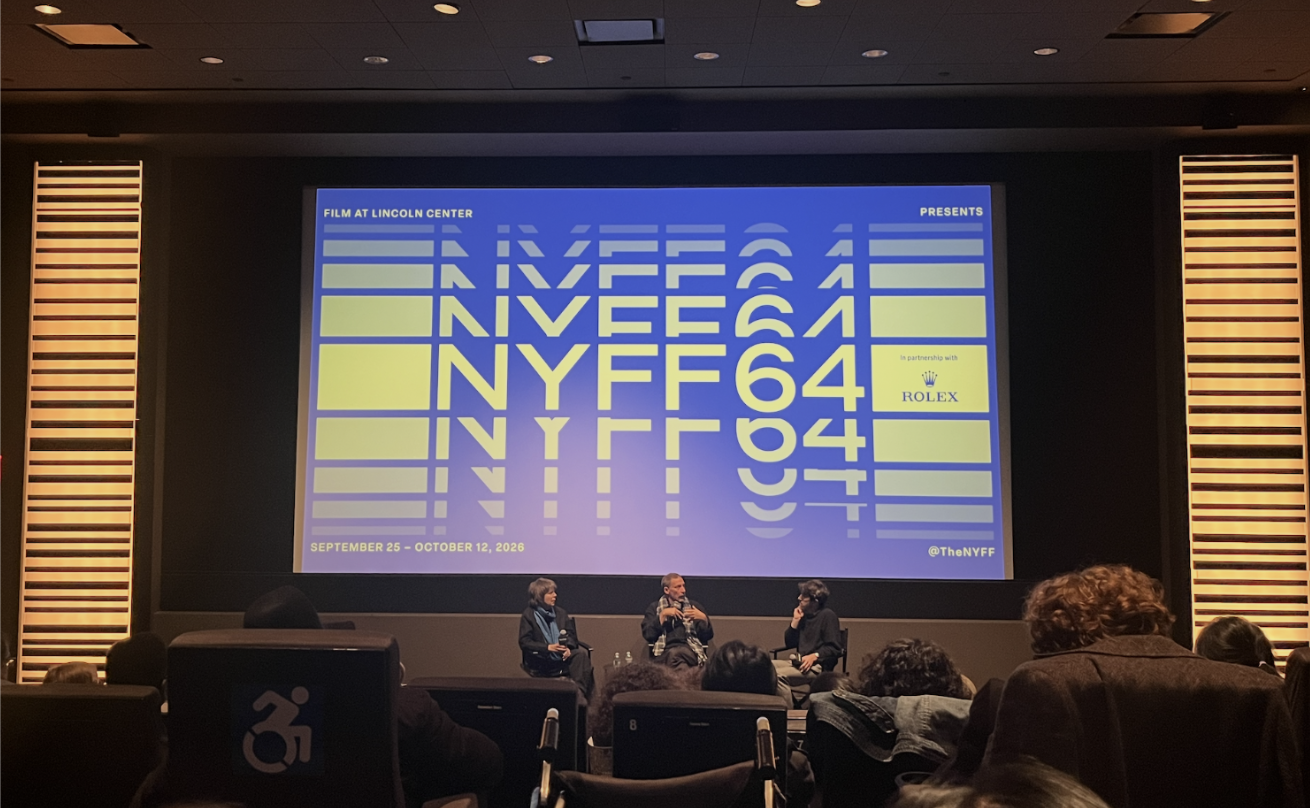
Editor Claire Atherton (left) and director Eric Baudelaire (middle) discuss their film with a moderator after their documentary’s worldwide premier at the New York Film Festival. (Image Credits: Alya Khoury)
When Kadiatou Diakite closes her eyes, it’s as if a light switch turns on. When she opens them, it turns off.
Diakite has been blind since birth. For her, seeing has nothing to do with vision. She sees through touch, smell, taste, sound. “These are my eyes,” she says in director Eric Baudelaire’s documentary “Car la Lune” (For the Moon), which premiered Oct. 6 at the 64th New York Film Festival.
In “Car la Lune,” blind and visually impaired students Diakite, Iris Fontanella, Jade Ebara Ossebi, Crystal Lau Chang and Mèï Jendoubi are Baudelaire’s “co-authors,” as he calls them. Carrying small handheld Sony cameras, they take turns sharing their lives over a two-year period at the National Institute for Blind Youth in Paris, where they wander the same halls as Louis Braille. (Braille invented the Braille system in 1824 while a student at this institute.) We hear their rich moments of laughter and music. And as the movie progresses, these five young women begin to trust us with moments of raw reflections about their experiences.
In one scene, Diakite sets the camera in front of her and lets the viewer into her brainstorming process, as she pieces together a poem about light – something she has never seen.
“Gentle and soft light
Unique within each for an inner peace
Gentle night in the world of dreams
Lighten up my inner world”
By using her imagination to describe what she cannot see, Diakite seems to demonstrate an example of neuroplasticity: the brain’s ability to repurpose its structures to adjust to different challenges — in this case, the absence of sight.
This specific case of neuroplasticity has been explored by many researchers.
In neurotypical individuals, the visual cortex is primarily responsible for sight. But when the brain does not receive visual inputs, it turns to other senses and cognition to fill in the gaps.
Marina Bedny, a psychologist at Johns Hopkins University, has explored how, in blind people, brain regions typically used for vision can be repurposed to do other tasks, like language, memory, and reading Braille.
Bedny’s team also compared the brain scans of sighted people and blind people as they were asked questions about color and light. “Not only do blind people share similar concepts when you ask them these questions, but they’re actually using similar neural structures to answer the question,” she explained.
Sighted people learn about color and light directly from seeing, but blind people learn about these concepts from other sources, like language, says Bedny. When it comes to the brain, though, “they kind of end up in the same place,” she says.
Baudelaire, the film director, is interested in firsthand perspectives, especially ones different from his own. “Car La Lune” is his second collaborative documentary. “For me, the film is really about perception,” he explained during a discussion following the premiere.
The brain has more than one way to learn and map the world, says Ione Fine, a neuroscientist at the University of Washington. The same brain regions that people with full vision use to recognize and respond to faces are active in blind people when they respond to voices, she says.
Johns Hopkins’ Bedny agrees. “One of the things that I’ve learned from working with blind people is that every person kind of adjusts their brain use during their early life towards the way that works for them,” Bedny says. “That’s the cool thing about the brain, is that it’s plastic and adjustable. ”
During the film’s discussion after the premiere, Baudelaire and the film’s editor, Claire Atherton spoke about their greatest challenges in creating the documentary. Atherton said that in the early stages of preparation, once they decided to make the students of National Institute for Blind Youth their subject, she couldn’t stop asking herself: “How can you show without seeing?”
Ultimately, their answer was to hand the camera to Diakite and her peers.
Filed To
Share
About the Author

Alya Khoury
Alya Khoury is interested in understanding how human health and the natural world fit together. She covers stories about environmental health, medicine, evolutionary biology and neuroscience.