Make education social again
Experts say more group work could help protect learning from AI’s long reach
Marta Zherukha • November 19, 2026
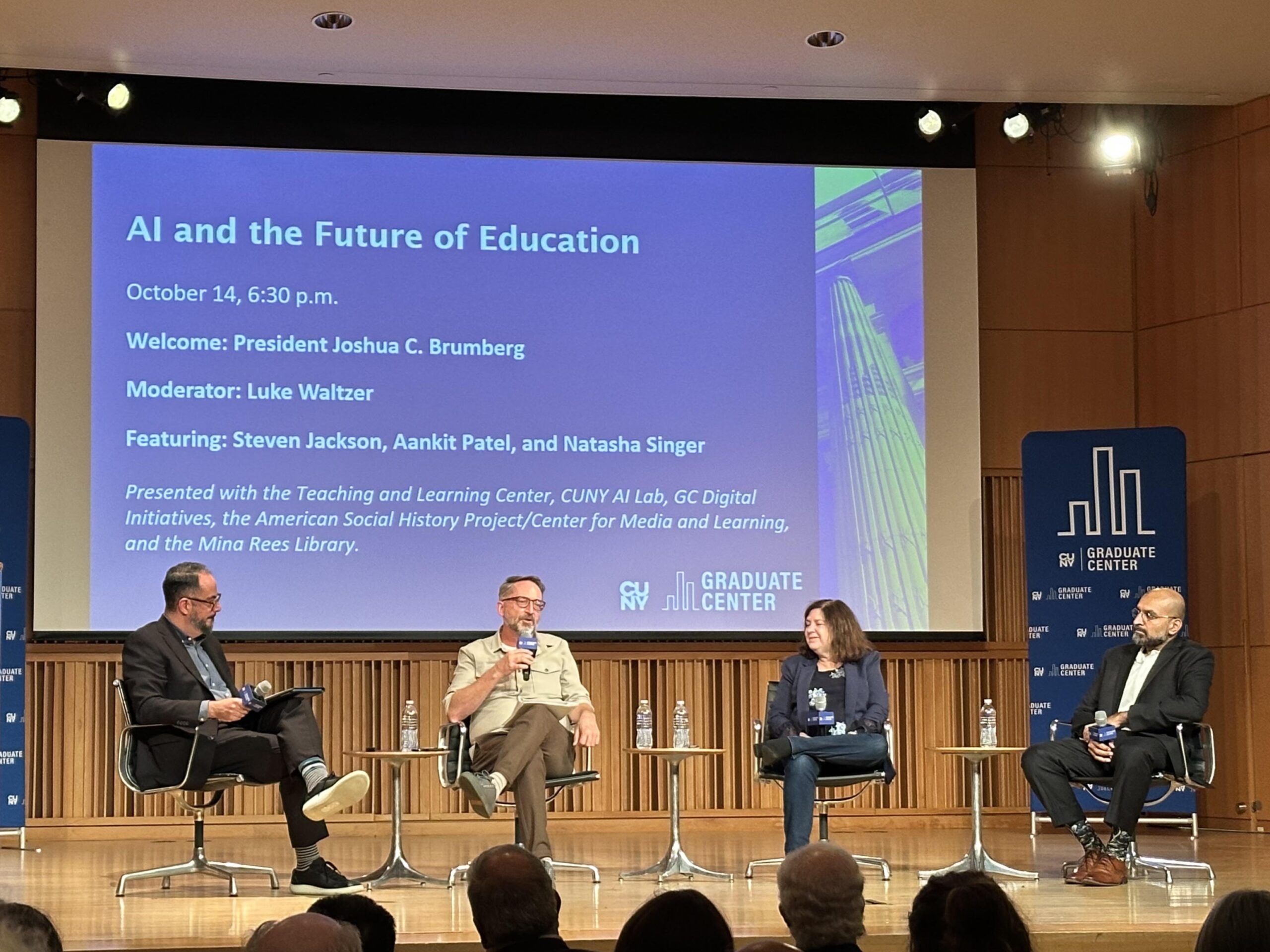
Teachers are moving away from individual, handwritten exams in favor of group testing and oral presentations in an effort to curb AI use among students. Luke Waltzer, Steven Jackson, Natasha Singer and Aankit Patel (left to right) on AI and the future of education. [Credit: Marta Zherukha]
Teachers are racing to restructure how they test their pupils to curb cheating with AI-generated answers. One potential solution: testing their knowledge in groups.
A growing trend is the “two-stage” exam, in which students first take their exams on their own before breaking into groups to do the exact same exam over again. Two professors at Cornell University, Doug McKee and Anne Bracy, test their students this way — with good results.
AI-proofing tests and assignments with group work will almost certainly increase the workload of already-overburdened professors, but it also is likely to improve learning, said Steven Jackson, who leads the Center for Teaching Innovation at Cornell. He spoke at an Oct. 14 event at The Graduate Center in New York City on the future of AI in education.
“It’s super powerful and effective because people are impassioned to get the answer right, so they’re really arguing or trying to convince each other,” Jackson said.
Jackson called this trend “resocializing” education. It’s a term that was used in the post-COVID era to describe people returning to society after a few months of social isolation — a little confused and awkward. In an AI world, he argued, students are similarly losing their social skills in ways that are disrupting their learning attitudes and performance. An article by the American Psychological Association in September says the use of AI “may interfere with the development of key social skills,” like interpreting body language and taking other people’s opinions, in teenagers.
A recent Harvard report says many student-teacher relationships have a new, unpleasant dynamic: Teachers are suspicious they’re reading chatbot-generated essays, and students feel their work and ethics are under constant attack. The result is two pairs of wary eyes, which is not a promising situation for productive learning, according to the report. Jackson thinks making kids talk to their teachers again could reverse that tension. Oral exams, even in STEM classes, are another way to force their hands.
“That’s time the student is interacting with their TA or their teacher,” and that interaction improves learning outcomes, he said.
Jackson says something that’s come with AI is less time spent in office hours. In the past, if students didn’t understand their homework or why they failed their exam, they had to ask their classmate, teaching assistant or professor. AI changed that. Students can look for an easy answer with the click of a button instead of working through difficult questions step-by-step with a classmate. “If your buddy Claude answers the question for you, you don’t need your neighbor anymore,” Jackson said.
Aankit Patel, another panelist, said while he thinks testing methods like group assignments and oral presentations are tempting, doing so requires resources that some colleges don’t have. A second group test on top of the already-existing individual tests would increase grading time, and it would certainly take more class time to perform staggered oral exams. Patel, the inaugural dean for technology and computer science at the City University of New York system, said CUNY lacks the workforce to implement it.
In either case, the idea of simply promoting conversation offers Jackson hope. It could also relieve some tension between students and teachers who keep those wary eyes on each other.
Most students don’t go to college to cheat on their homework, said Kate Kinney, a dean at Suffolk County Community College, a State University of New York System school. They start with good intentions, she said, but things pile up along the way. They just don’t want to fail.
As AI becomes more prevalent in the daily lives of students, cheating may rise alongside it. A recent study in Science found 26% of students who use generative AI daily have cheated on academic work, compared to 7% of those who use it monthly. The same study said science, technology, engineering and mathematics (STEM) students use AI more frequently than their peers in the humanities, with computer science students using GenAI at a rate three times higher than those in the arts.
“Learning is meant to be a little bit hard,” Jackson said. AI “is taking the friction out of learning, and the friction is where the learning lives.”
Filed To
Share
About the Author

Marta Zherukha
Marta Zherukha studied journalism and international studies at the University of Florida before joining SHERP. The first article she published was on Florida’s springs, and she’s been obsessed with sharing science stories ever since. Marta is most interested in the environment and public health, but she finds new science topics to dive into every day.