Real resurrection or genetic illusion?
Gene editing could restore populations and bring back extinct animals, but some experts are skeptical of the hype over so-called ‘de-extinction’
Maia Chandler • November 28, 2026
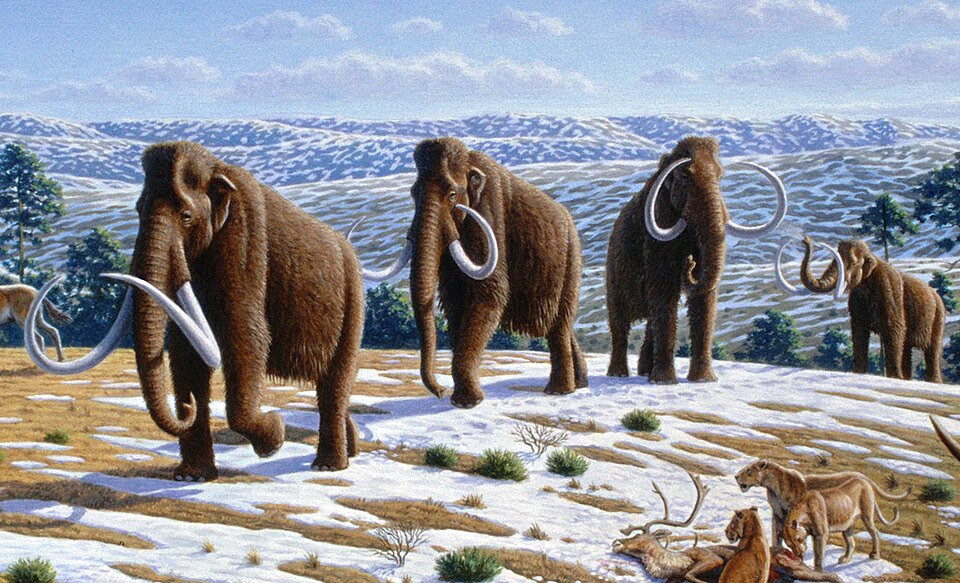
Colossal Biosciences wants to bring back the wooly mammoth. But is de-extinction science fact or science fiction? [Credit: Mauricio Antón/Wikimedia Commons | Creative Commons Attribution 2.5 Generic]
Last year, Colossal Biosciences announced that they brought back the dire wolf. Now, Beth Shapiro says that they’re working on bringing back the mammoth. And the dodo. And the Tasmanian tiger. She’s the Chief Science Officer of Colossal, working on what she calls “functional de-extinction.”
Shapiro spoke recently at a webinar facilitated by New York University’s Center for Synthetic Regulatory Genomics on the science behind genome engineering for conservation, de-extinction and ecosystem health.
Essentially, she’s trying to find the particular genes that epitomize an extinct animal and then insert them into the DNA of its nearest relative. The goal, as broadcasted in the webinar: create a living mammoth-like creature from ancient genetic material and an Asian Elephant.
“I want to make the fewest number of changes that I can in order to de-extinct the key phenotypes,” she said in an interview with Scienceline.
Shapiro told the audience she wants to bring large animals back to the steppe ecosystems where they once churned the soil, “spreading seeds and creating mosaic landscapes,” she says.
But even her collaborators say Colossal’s marketing claims overstate what it can actually do.
De-extinction, so far, “is a fairy tale,” says David Díez del Molino, a researcher at the Centre for Palaeogenetics in Stockholm who has worked with Colossal on mammoth research. He would love to see mammoths back, he says, “but I do not believe in fairy tales.”
“I have a sneaking suspicion that the audience is already people who think that this is a good idea,” Shapiro said before the Langone event. But if the webinar audience was mostly friendly, the larger conversation over what Colossal and several other genomics start-ups are attempting is highly controversial.
For those attempting it, de-extinction isn’t easy. It involves several research stages, according to Ben Novak, lead scientist for the conservation non-profit Revive & Restore, who also spoke at the webinar. Novak leads a project working to write passenger pigeon genes into the DNA of band-tailed pigeons, to “produce a new kind of species that takes the ecological place of passenger pigeons.”
First, scientists need to sequence the passenger pigeon genome. They need to figure out what specific genes do and find the ones that correspond to the unique traits they desire. For passenger pigeons, that’s their hypersociality and fancy tails, Novak says. Then they can edit those genes into band-tailed pigeon cells and use those cells to make pigeon chicks. That’s the hard part, Novak says, especially with birds.
And, despite Colossal’s viral claims that it brought back the dire wolf, “de-extinction hasn’t happened yet,” Novak says. “It’s all been speculation and hyperbole.”
Colossal announced the resurrection of the long-dead dire wolf in April 2025. The three pups were delivered by domestic dog surrogate mothers between fall and winter 2024. Since the announcement, the wolves have been kept in a secret location hidden from prying eyes, but no long term plans have been announced for the trio, christened Romulus, Remus, and Khaleesi. As of last month, Romulus and Remus have grown up, weighing in around 60 kg each, and Khaleesi is racing to catch up.
De-extinction draws a lot of attention, Novak says, but other technologies such as gene drives, which manipulate inheritance so that a desired version of a gene gets passed on, have caused more public controversy.
Gene drives and other genome engineering technologies used to support endangered species, he says, are “imminently more real than de-extinction.” This includes introducing genetic diversity into dwindling populations, preserving living cells of wildlife for future genetic rescue projects, or engineering a species to be resilient to disease.
For years, Revive & Restore has been working on rescuing the black-footed ferret. Once feared extinct, the black-footed ferret was re-discovered in 1981. But, there were only 24 individuals, a number that spelled doom for future genetic diversity.
Now, all 12,000 black-footed ferrets are descended from a group of seven. That level of inbreeding lowers fertility and increases mortality, making them especially vulnerable to extinction.
Revive & Restore wants to combat inbreeding by introducing the descendants of an eighth black-footed ferret into wild populations. They also want to integrate DNA from museum specimens into living ferrets.
But any kind of genome editing raises concerns, according to Vincent Lynch, a geneticist at the University of Buffalo.
The problem, he says, lies in knowing what genetic variation is beneficial versus harmful. “And how do you figure that out? What if the genetic diversity you introduce has deleterious consequences? Now you’ve just made the thing worse,” Lynch says.
New genes may interact in unpredictable ways with environmental cues. For example, in people, some genes increase susceptibility to asthma when combined with air pollution particles.
An introduced gene could also negatively affect an existing gene, Lynch says. For example, gene interactions may increase the severity of an inherited disease. Inserting new DNA might have no effect at all—or possibly massive effects.
And if genome engineering is successful, another question arises: where should these revived creatures go?
While Shapiro says that the de-extinct mammoth could help restore the steppe ecosystem, Lynch calls her claim “extremely bad evolution, and it’s extremely bad ecology.” So much has changed on what was once the steppes of Eurasia and North America — including a much warmer climate — that mammoths couldn’t possibly fulfill their former niche.
“The environment isn’t static. It’s been evolving since the loss of those organisms. That’s not the reintroduction of an animal into its old environment,” he says. “That is putting an animal into a new environment, which is an invasive species.”
While some people are concerned that focusing on de-extinction takes away from conservation efforts, Shapiro disagrees. “The point that I always love to make, and I wish people would get, is like we’re doing both of these things,” Shapiro says. “They’re the same tools.”
Filed To
Share
About the Author

Maia Chandler
Maia is a Brooklyn-based science journalist. They have an academic background in biology and physics, and their work has appeared in Physics Today.