Bald eagles came back to the Channel Islands, but the hard part isn’t over yet
New threats are testing one of America’s most successful wildlife recovery efforts
Nhung Nguyen • November 26, 2026
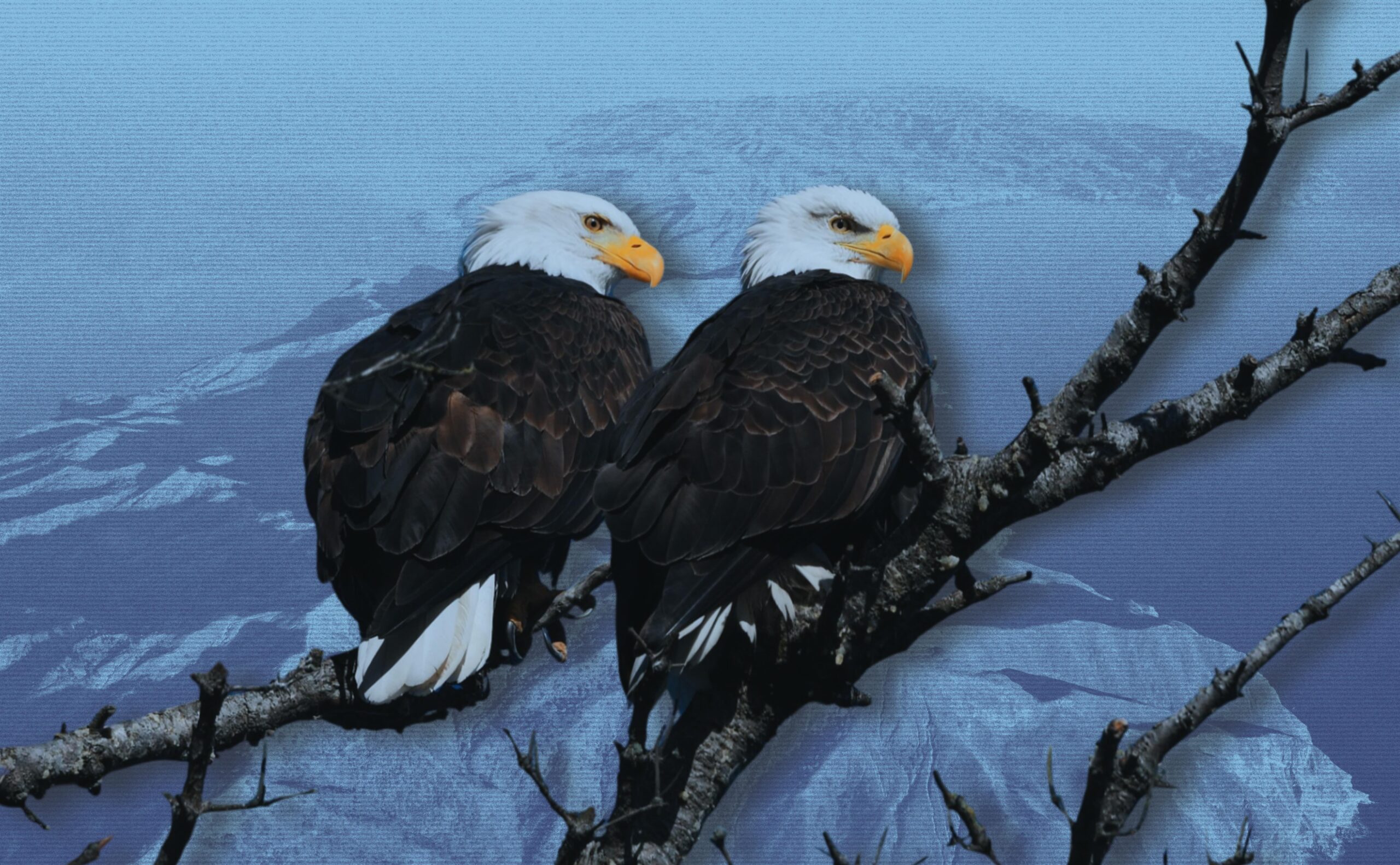
A pair of bald eagles appear against an aerial view of Santa Cruz Island in California’s Channel Islands National Park. [Illustration credit: Nhung Nguyen. Images Credit: Soly Moses | Pexels, Veronika_Andrews | Pixabay]
At 7 a.m. one April morning earlier this year, Erin Weiner’s emails started to ping. Weiner, the eagle project lead on California Channel Islands for the nonprofit Institute for Wildlife Studies, was having coffee before logging on for work. Strangers watching a live feed from the Islands were sending a stream of alerts: Ryder, a baby bald eagle, had just fallen out of a nest.
The fluffy gray eaglet’s plumage hadn’t yet fully developed when he wandered a bit too far from his two sisters to the edge of their massive, bowl-shaped nest on Fraser Point. Their parents were away hunting.
Ryder soon tumbled over.
Most days, it would have taken Weiner a long time — perhaps even too long — to get there for the rescue. She is the only full-time biologist left at IWS, covering the archipelago of eight islands scattered 12 to 70 miles off the Southern California coast. To reach one, she needs to be ferried out from the inland office, or hop from another island.
But luckily for Ryder, she was already on the same island that morning, just a short hike away from the nest. Weiner climbed to him with an assistant and gave him a once-over. “There was no visible injury,” Weiner recalled, so she “put him back in the nest.”
This small save is part of a long history. Ryder and his sisters hatched into a storied bloodline that represents one of America’s greatest wildlife comebacks. His mother, Cruz, made history in 2006 as the first known bald eagle chick born in the wild on the Channel Islands after the species had been poisoned by the pesticide DDT, and vanished for decades.
This year marks another milestone: San Miguel, the most remote island, welcomed its first chicks since the early 1950s, adding to a total of 16 island-born babies across the park. “Eagles continue to reclaim portions of their historic range,” Annie Little, supervisory ecologist from the National Park Service at Channel Islands National Park, said in an email to Scienceline. “The population is now considered healthy and self-sustaining.”
That success is changing the nature of the job. “The challenge is no longer simply getting eagles established on the islands,” Little said. Now, “it’s understanding and monitoring a naturally functioning population over the long term.”
That’s going to require more than just a few trail cams. DDT was a single threat that could be traced and controlled, said Yiwei Wang, Senior Director of Conservation of Audubon California, a non-profit conservation advocacy group. What bald eagles, alongside other birds, have to deal with now come from many directions at once. Increasingly intense storms and fires are ravaging the islands, all while a major change to the Endangered Species Act could thin protection from the habitat that the birds rely on. “They are facing habitat loss and climate change,” said Wang. “There’s not one cause that you can just stop.”
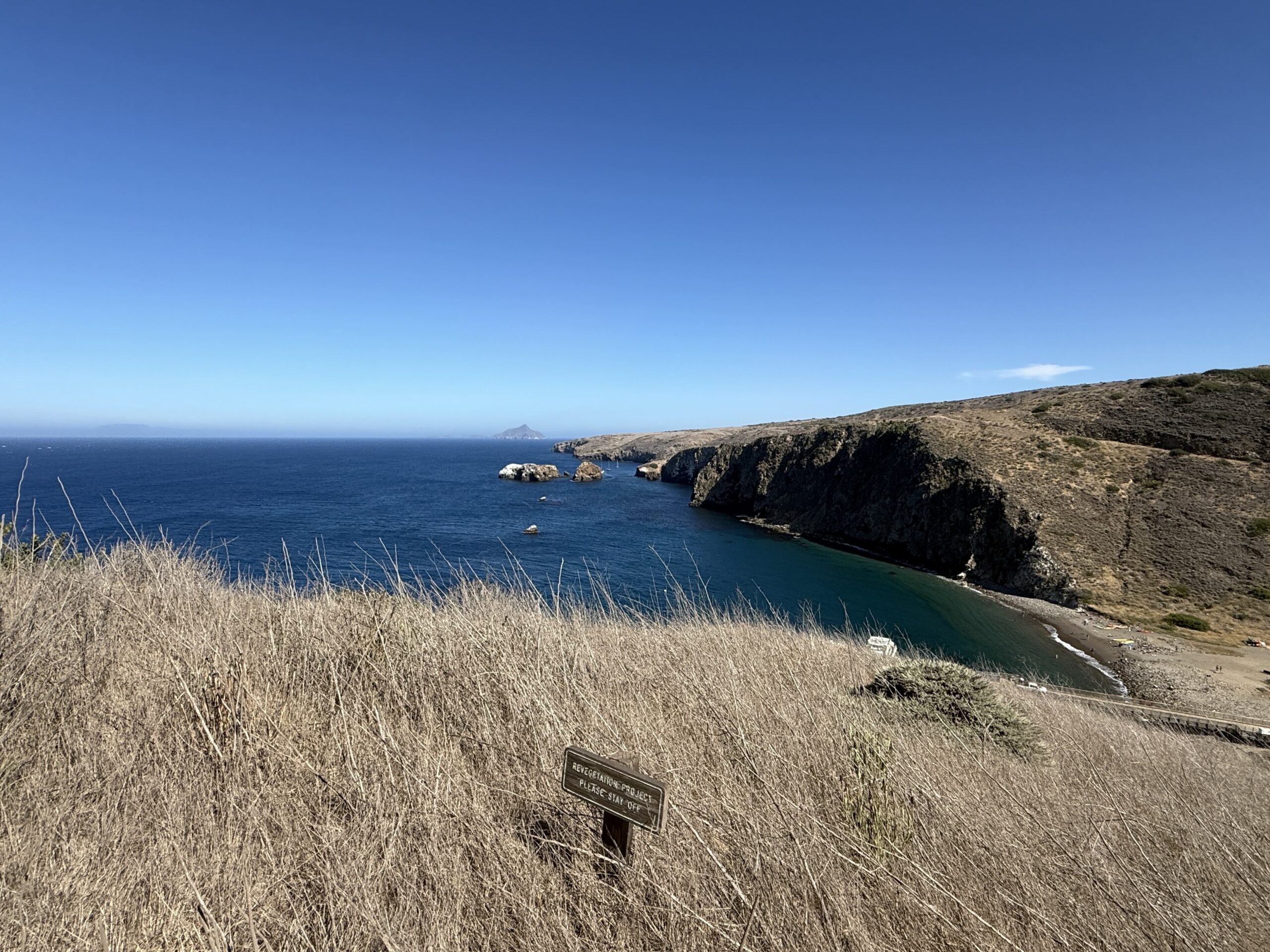
The rugged coastline of Santa Cruz Island, the largest of the five islands in California’s Channel Islands National Park. The whole archipelago consists of eight islands miles off the Southern California coast. [Credit: Nhung Nguyen]
Decades of helicopter stunts and nursery work
Nearly all of Southern California’s breeding seabirds come to Channel Islands National Park to nest, thanks to the archipelago’s isolated and predator-free environment. Half of the world’s western gulls (Larus occidentalis) and ashy storm-petrels (Hydrobates homochroa) settle in the park’s rock caves, crevices and shrubs, as do most of the country’s rare Scripps’s murrelets (Synthliboramphus scrippsi), a bird resembling flying, robin-sized penguins.
The bald eagle (Haliaeetus leucocephalus) sits above them all. “They are the top predator — they’re a very good indication of the overall ecosystem health,” said Peter Sharpe, IWS’s former director of the bald eagle and peregrine restoration project. “If the eagles are doing well, it most likely means that the fish in the ocean are doing well, the seabirds are doing well.”
Before the 1960s, eagles were a familiar sight across the islands; accounts dating back to the 19th century described distinctive white heads soaring above the rocky cliffs and pinnacles. But by the mid-20th century, the birds vanished without a trace from the park. In 1978, five years after the enactment of the Endangered Species Act, the bald eagle was listed as endangered, not just on the Channel Islands, but throughout the lower 48.
In 1980, when the IWS started a project to bring bald eagles back, researchers simply caught wild birds from the Pacific Northwest and released them onto Catalina Island. But there was a problem: every egg they laid broke before hatching.
It wasn’t until 1989 that researchers realized why. Between 1947 and 1961, the Montrose Chemical Corporation had dumped barrels containing hundreds of tons of waste contaminated with the powerful insecticide DDT off the coast of Southern California. The chemical was banned in 1972, but DDE, its stubborn breakdown product, stayed in the ocean. It seeped into the marine food web, getting into fish, eels and gulls — bald eagles’ favorite meals — and caused the pairs to lay eggs with shells so thin that they crumbled under the mother’s weight.
So the IWS team decided to incubate fragile eggs themselves. Sharpe believes he is among the few people on earth to have been dive-bombed by bald eagles while carrying out the task. As the project’s research ecologist from 1997 until his retirement last year, he would hang over cliffs while tethered below a helicopter to swap the newly-laid eggs for fakes. “I sort of have a fear of heights,” he said, “so the first couple times dangling 100 feet below a helicopter and a 1,000 feet above the ocean was a bit nerve-racking.”
Using incubators on Catalina Island, the team would become the eggs’ surrogate parents for a week. Hatching eaglets out could “fit in the palm of your hand,” Sharpe recalled. “They just look very fragile.”
He fed them ground quail meat using ice-cream spoons, and wore a fake eagle puppet on his arm so the babies would not get accustomed to human feedings. When the fostered eagles were ready, Sharpe and other researchers hiked back to their nests and reunited them with their parents. In 2000, four companies, Montrose included, agreed to pay $73 million in settlements to federal and state environmental agencies, with funds going to restoring marine and avian wildlife, including the eagle project. With this big financial boost, IWS was able to release 61 more eagles in the Northern Channel Islands. Then, in 2006, Cruz was born in the wild.
Artificial incubation ended in 2009. By 2022, about 60 bald eagles lived in the park, including multiple generations of island-born birds.
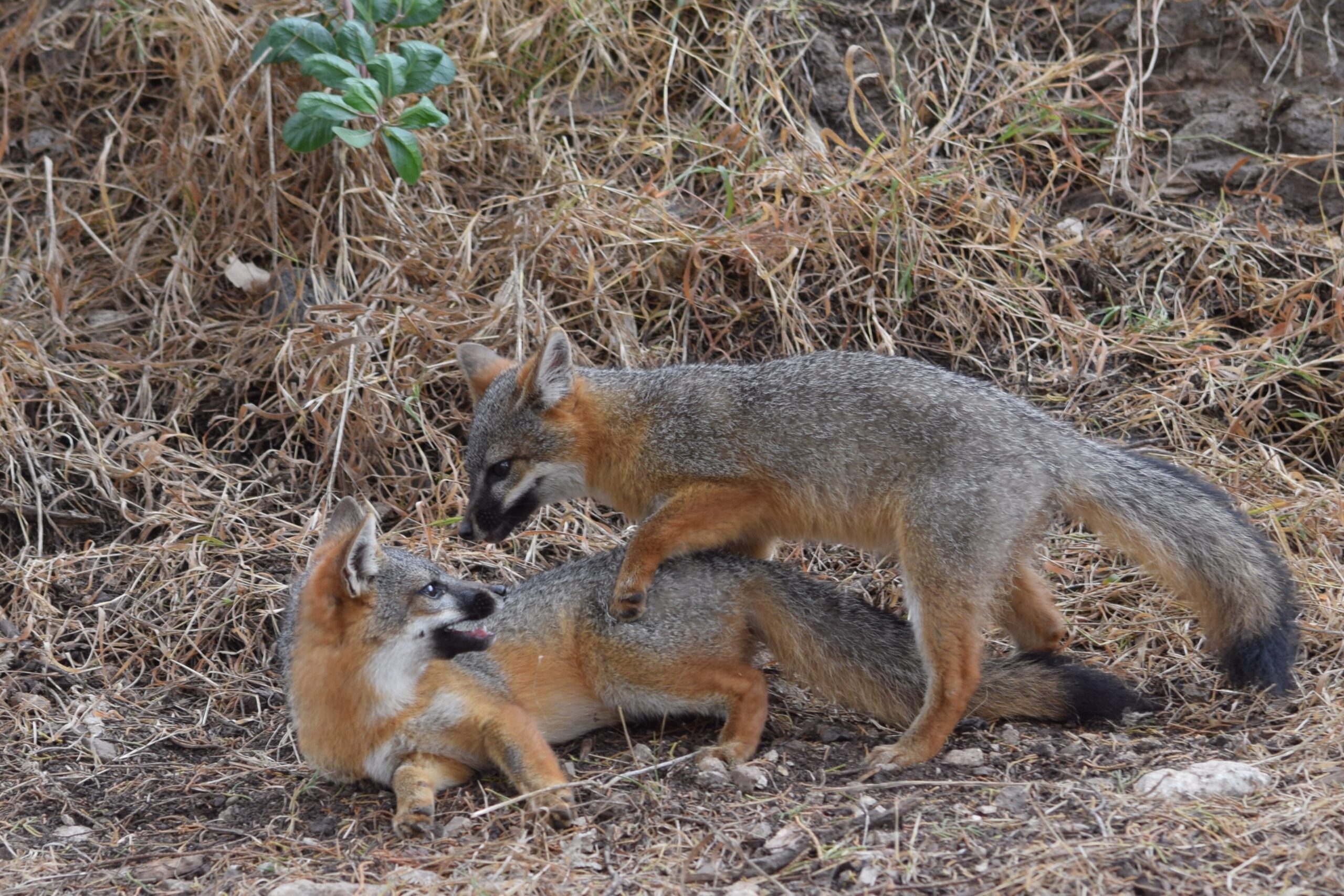
The decline of island foxes (Urocyon littoralis), a subspecies native to six of the eight Channel Islands of California, was considered “a classic story of unintended consequences”. Their numbers plummeted in the late 1990s following the disappearance of native bald eagles and a sudden invasion of golden eagles to the islands. [Credit: Ken Bosma | Wiki Commons CC BY 2.0]
Mending a web
Bald eagles were not the only ones to return.
Across the Channel Islands, other native species had been pushed to the brink after a century of man-made problems: pesticide poisoning, pigs abandoned by ranchers trampling grasslands and young oaks, and invasive black rats — stowaways from ships and boats — preying on seabirds’ eggs and chicks. The feral pigs also lured in golden eagles from the mainland.
While the bald eagles were away, the dark-plumaged raptors, their competition absent, invaded the skies and hunted the endemic island foxes to the brink of extinction. The housecat-sized foxes had evolved alongside bald eagles, predators that largely feed at sea. They were less ready to cope with the newcomers who proved to be “really, really smart and savvy hunters,” as Weiner put it.
The National Park Service launched a years-long campaign to eradicate invasive species, killing thousands of feral pigs, trapping the colonizing eagles and ending sheep grazing. The foxes rebounded. Once down to just 15 individuals, they now grew to thousands under the bald eagles’ watch. Common murres, brown pelicans and Scripps’s murrelets also thrived back on the Channel Islands after decades of restoration projects.
After the winged residents bounced back, long-term monitoring is still essential, said Little, the ecologist from NPS. “A self-sustaining population doesn’t mean every nest succeeds,” she explained. “Eggs can fail, adults can die or be displaced, nests can collapse and environmental disturbances can affect individual territories.”
For example, this May, a historic wildfire broke out on Santa Rosa Island and was not contained until June. Whipping winds fed the fire and held up firefighters, whose access to equipment and the island itself was already limited. By the time it was out, the blaze engulfed roughly a third of the area and killed an eaglet in an active nesting territory. “Even after a population has recovered,” Little said, “individual birds and nesting territories remain vulnerable to environmental disturbance.”
Yet “the more areas you have them nesting, the safer the population is,” said Mike Parker, who leads the California Institute of Environmental Studies, another nonprofit that works to protect seabirds and restore their habitats on the islands. If one disaster takes out a colony, the species can survive in another, he explained.
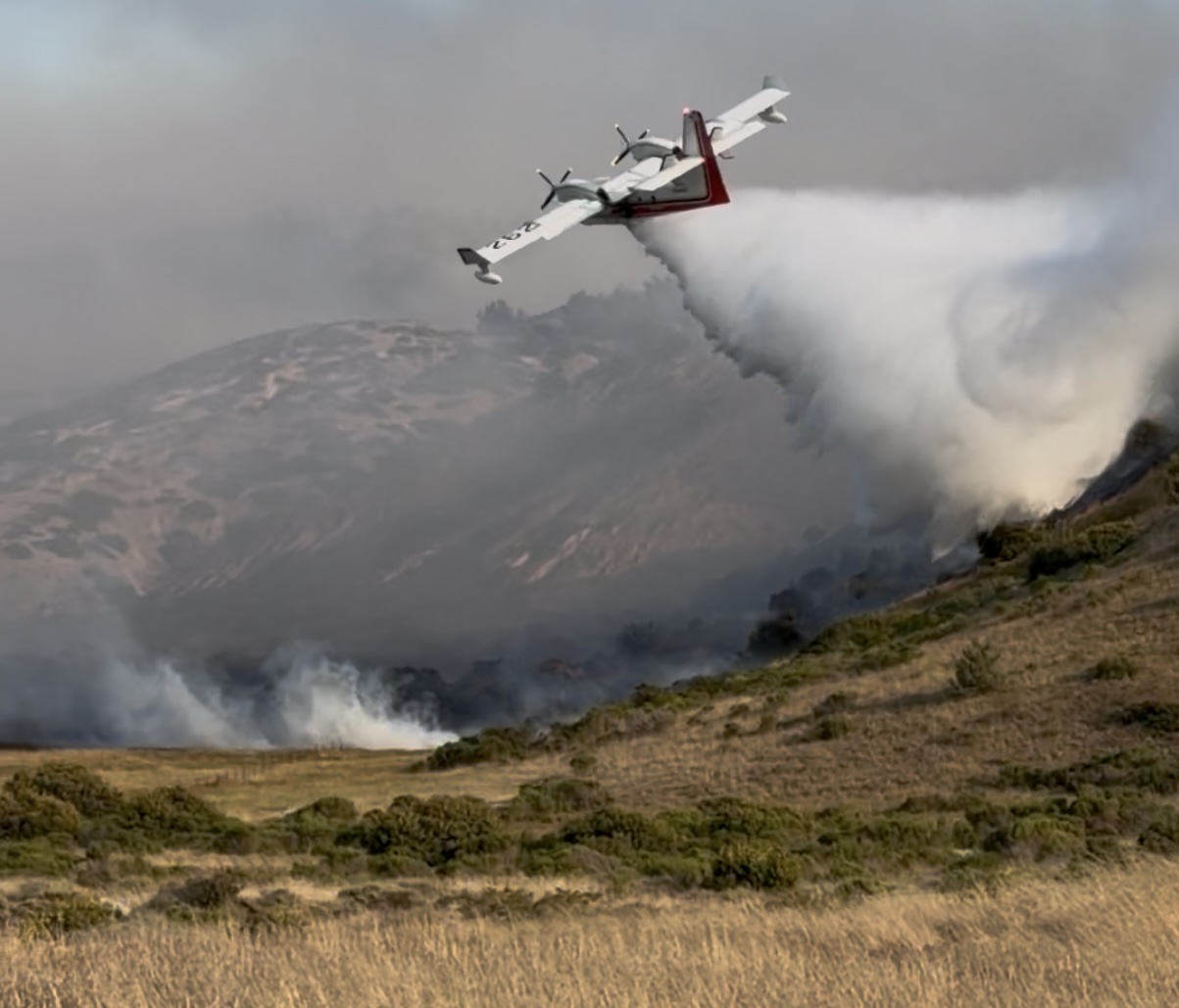
A water-scooping aircraft drops water on the Santa Rosa Island Fire on May 19, 2026. The historic fire — the largest recorded in the Channel Islands — reportedly broke out after a sailor crashed a boat into the rocks on the island’s shore. [Credit: J Foye / U.S. Wildland Fire Service via NPS]
More work ahead
The seabirds’ haven has turned out to be a tough and expensive workplace for conservationists, whose funding and staff are shrinking.
Researchers continue to track their health and their movement among islands via trail cameras and live webcams, but those devices cannot entirely replace legwork.
At IWS, Weiner covers miles of coastline, steep ridges and deep canyons across the islands, and from time to time needs to hike for eight hours to check on the eagles and the nests. “The birds can occupy anywhere,” she said. “They definitely aren’t choosing their nesting habitat with me in mind.”
Getting people, equipment and materials to the remote islands also comes with hefty bills. The two islands within the park that have the largest population of seabirds are also the smallest, without any fresh water, according to Parker. “To do restoration on these islands, it costs three or four times the amount of money it would take to do the same restoration on the mainland,” he added.
The $13 million from the Montrose settlement funding has been running out since 2017. Federal budget cuts in 2025 dealt another blow to the Channel Islands, forcing a 10% decrease on top of an already thinning roster of park employees and scientists.
IWS’s eagle team has been downsized, from a team of six members to just Weiner. Its budget has also been slashed by half, now relying more on small private donations.
Parker’s CIES had to cut back work and monitoring tasks too, after losing “somewhere between 25 and 50%” of its federal funding. California’s newly passed funding for wildlife restoration works came to the project’s rescue. “It hasn’t been a complete loss, but without those state funds, we’d really be in a bind,” Parker said.
Shifting winds
Meanwhile, the sea and the islands themselves are changing thanks to climate change. With more frequent and bigger storms, Parker’s team often see nests of ashy storm petrels and Scripps’s murrelets getting washed out to sea — something “we didn’t have to worry about in the 1990s,” he said.
But the newest threat comes from Washington. The Trump administration in July announced major changes to the 53-year-old Endangered Species Act, the law credited with helping to save bald eagles and many other species. The new rule makes it easier to damage habitat that endangered and migratory species rely on.
Although bald eagles were delisted from the endangered species list in 2007, Wang from Audubon California believed the changes could still harm the islands’ wild birds. Bald eagles could find nesting trees at risk, she argued, while many migratory birds could lose their rest stops along their flyways. “If you take away the tool to protect the habitat, that takes away your biggest tool to conserve species,” she said.
If the era of DDT contamination offers any lessons, the researchers say, it’s that environmental damage could take many years and persistent work to undo. Restoration works, said Little, Sharpe and Parker, but slowly. “It takes so little time to destroy something and so much time to restore something,” Parker added.
“The bald eagle success story is a true success story,” Wang said. “But today, there are so many more threats.” She sees the bald eagles as part of an interconnected web of species. “Any part of the web is an important node,” she added, “so if we lose too many of those nodes, your web is going to collapse.”
This means every individual counts. After his first fall, Ryder slipped off the tree again in June. That time, part of the nest’s lip crumbled under his feet, but he had become a fledgling and was already learning how to fly. Footage from the live feed a few days later showed him perched on a branch nearby, no help needed from Weiner.
He has since left his nest.
